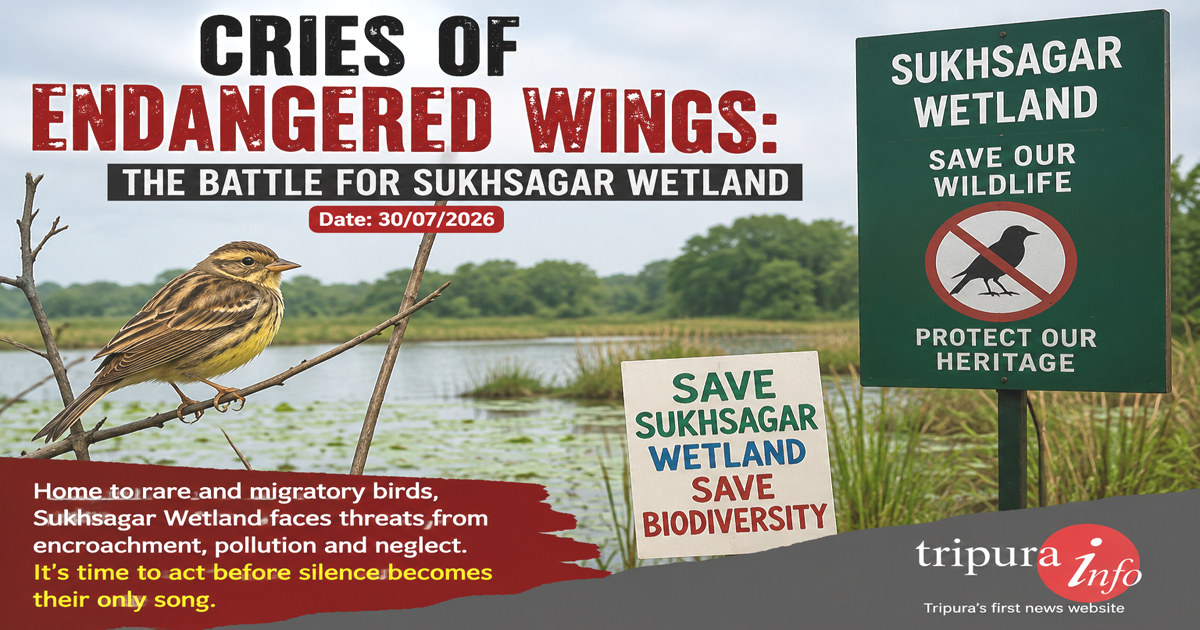
Cries of Endangered Wings: The Battle for Sukhsagar Wetland
Ahili Dutta, a Class IV student of St. Joseph School, Gokulnagar, Tripura
July 30, 2026
The
legendary British playwright George Bernard Shaw once issued a profound
warning: *“Nature may have tricks up her sleeve to check us if the chemists
exploit her too greedily.”
Standing
in 2026, as the world celebrates the birth centenary of Sir David Attenborough,
Shaw’s words manifest as a grim reality at the historic Sukhsagar Wetland in
Tripura’s Gomati district. Driven by unbridled human greed, chemical pollution,
and ecological apathy, this internationally acclaimed wetland stands on the
precipice of catastrophic collapse.
The
Golden-Breasted Guest
From
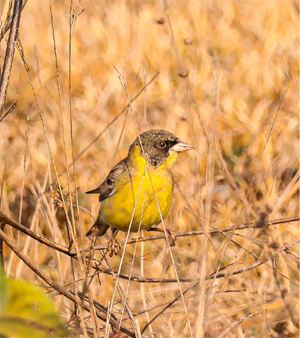
September through May, the shimmering waters of Sukhsagar host over 300
migratory bird species. The most ecologically significant among them is the
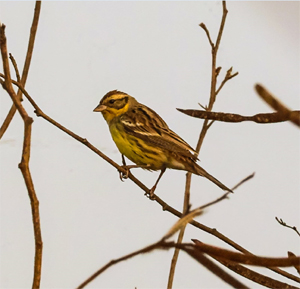
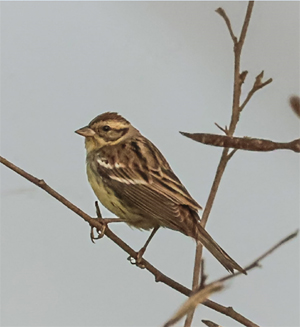
Yellow-Breasted Bunting (Emberiza aureola), a striking sparrow-like passerine
distinguished by its vibrant golden plumage.
As
a gregarious species, their foraging patterns rely on Sukhsagar’s peripheral
grasslands, reed beds, and low-lying paddy fields. At dawn and twilight, they
descend in coordinated flocks to feed on aquatic insects and wild seeds,
bringing the skies to life with their flutelike whistles.
● Landmark
Documentation of 2026:
In
February 2026, local researchers successfully sighted and documented this
Critically Endangered species at Sukhsagar, proving it remains an indispensable
stronghold for the vanishing bird.
However,
human encroachment has fractured these natural rhythms. The Yellow-Breasted
Bunting is timid and skittish; noise pollution, mechanical agricultural clamor,
and artificial night lighting threaten to alter their migratory corridors
permanently.
A
Global Emergency: Plummeting Numbers
 In
2017, the IUCN elevated the species to Critically Endangered.'
In
2017, the IUCN elevated the species to Critically Endangered.'
By
2024, the global population had dwindled to roughly 180,000 individuals due to
three primary drivers:
● Rampant
Illegal Poaching:
Heavily
targeted along East Asian flyways, particularly in China, where they are
trapped en masse as the culinary delicacy 'rice bird.'
� �Systemic
Habitat Loss:
Breeding
and wintering grounds are rapidly converted worldwide for urban expansion and
intensive agriculture.
●
Agro-Chemical Interventions: Excessive pesticide use obliterates their primary
food source while subjecting survivors to secondary poisoning.
Localized
Threats: Encroachment and Urbanization
While
the species faces global perils, the localized crisis within Sukhsagar is
alarming:
● Illegal
Land Encroachment:
Land
mafias are progressively draining, backfilling, and altering the natural
contours of the wetland, erasing critical shallow-water foraging grounds.
 ● Udaipur
Railway Station Expansion: Ongoing infrastructural overhauls have introduced
persistent acoustic and structural disturbances, shattering the tranquility
required by migratory avifauna.
● Udaipur
Railway Station Expansion: Ongoing infrastructural overhauls have introduced
persistent acoustic and structural disturbances, shattering the tranquility
required by migratory avifauna.
● State
Urbanization Master Plan:
A
massive urbanization blueprint around the railway station—comprising commercial
hubs and high-density housing directly on the ecosystem's fringes—threatens to
trap Sukhsagar inside a concrete jungle.
Emergency
Conservation Architecture
If
state initiatives are not realigned with eco-sensitive frameworks, Sukhsagar
faces imminent ecological extinction. Authorities must execute a war-footing
intervention:
1. Protected
Status: Formally notify Sukhsagar as a 'Community Reserve' or 'Protected
Wetland Sanctuary' under the Wildlife Protection Act with strictly mapped
boundaries.
 2. Rail-Urban
Buffer Zone:
2. Rail-Urban
Buffer Zone:
Mandate
a minimum 500-meter to 1-kilometer 'Green Buffer Zone' featuring dense acoustic
green belts around the wetland.
3. Chemical-Free
Farming:
Prohibit
synthetic pesticides in the catchment area, supporting local farmers in
transitioning to organic agriculture alongside drone-based surveillance.
Development
is necessary for human progress, but it must not come at the cost of silencing
a Critically Endangered species. In this centennial year of Sir David
Attenborough, Tripura's ultimate test lies in harmonizing infrastructure with
ecological preservation, ensuring the Yellow-Breasted Bunting's song continues
to echo across Sukhsagar.
(This
article has been written by Ahili Dutta, a Class IV student of St. Joseph
School, Gokulnagar, Tripura, as part of the Nature in Focus (NIF) initiative.
Ahili is the daughter of Senior TCS Officer Arup Kumar Dutta and has
contributed this article out of her interest in nature and environmental
awareness)
(Tripurainfo)
more articles...