The Emblem as a Metaphysics of the Spirit!!!
Biswanath Bhattacharya
February 12, 2026
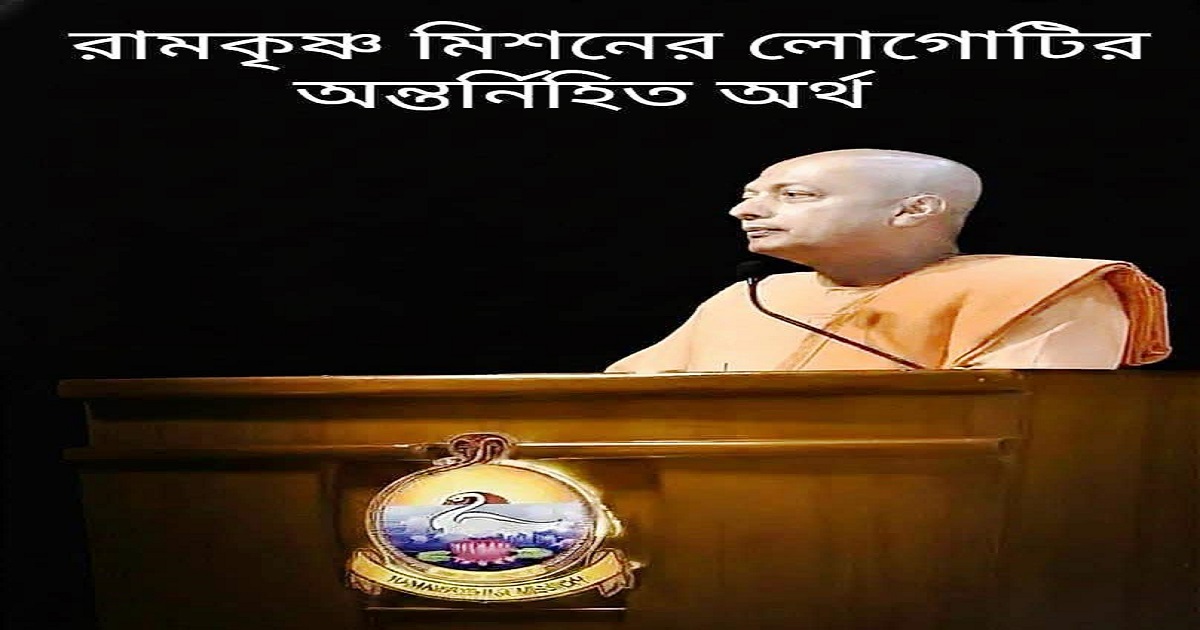
There exists a chasm, sometimes unbridgeable, between a symbol that merely decorates and one that discloses. Decorative symbols are often content to remain at the surface, pleasing the eye but leaving the heart untouched. Yet, some symbols serve as living scriptures, unfurling truths that words can barely contain. The emblem of the Ramakrishna Mission belongs firmly to the latter. It is not a badge, but a beacon—a metaphysical equation rendered into form by Swami Vivekananda, who sought not only to represent but to reveal the unity of spiritual pursuits and the essence of the soul’s journey.
In the closing days of the 19th century, Vivekananda, meditating on the banks of the sacred Ganges, conceived an emblem that would be the Mission's defining seal. This image, born of contemplation and profound insight, was drawn out for his brother-disciples as a map of the spiritual cosmos. Each line, each curve, was infused with meaning—carefully chosen to disclose rather than obscure. It is said that Vivekananda explained his vision with the precision of a philosopher and the heart of a poet, every element revealing a facet of the soul's quest.
The emblem unfolds itself in layers. At its centre, a swan glides upon waveless waters, serene and self-contained. In Indian metaphysical tradition, the swan, or hamsa, is not merely a bird—it is the soul itself, capable of discerning the real from the unreal, the eternal from the ephemeral. Above, the sun rises, its rays suggesting the illumination of knowledge, dispelling the darkness of ignorance. On one side, a lotus blooms, pure amidst mud and chaos, invoking the ideal of spiritual unfolding even in the world’s turbulence. The serpentine wave at the base is not just a flourish but the ceaseless motion of life, the rhythm of karma and the restless striving of humanity. Encircling all is the serpent, symbol of kundalini, the latent spiritual energy coiled within every being, waiting to awaken and rise through the chakras towards transcendence.
Each component is a gateway—a door opening onto a different yoga. The swan is jnana, the wisdom that discerns; the lotus is bhakti, devotion that blossoms in the mire; the waves are karma, the action that shapes destiny; and the serpent is raja, the mastery of mind and energy. The emblem thus becomes a metaphysical equation, where these yogas are not isolated pathways but strands in a single tapestry, each necessary for the soul’s ascent. The emblem does not simply instruct; it invites. It is a gentle hand, guiding seekers to understand that the spiritual journey is neither linear nor exclusive, but an interwoven dance of knowledge, love, action, and discipline.
More subtly, the emblem is a map of unity—a silent affirmation that every spiritual tradition, every sincere quest, is ultimately convergent. Swami Vivekananda’s vision was not to champion one method over another, but to awaken the conviction that all paths, rightly travelled, lead to the same summit. In the emblem’s geometry and elements, the unity of the yogas is both metaphysical and practical. It is not a theoretical unity, but an experiential one, lived daily in the Ramakrishna Mission’s ethos and the inner life of its seekers.
The emblem, then, is not an ornament upon a letterhead, but a living icon—a metaphysics of the spirit cast in the language of symbol, inviting contemplation and awakening. It is as if a river finds its voice in a song, with each element adding a note, each note resonating with depth and clarity. The emblem becomes a mirror in which the soul glimpses its own possibilities, its latent grandeur, its aching longing for unity.
In the epilogue, let us turn to the Bengali heart, where the emblem’s resonance is felt not merely as a design but as a living flame. To gaze upon it is to watch the sunrise over the Ganges—the waters shimmering with the promise of awakening. The emblem is a lamp that neither flickers nor fades, even in the winds of adversity. It is a canvas upon which the spirit paints its aspirations and doubts, its certainties and hesitations. Like the swan that glides across waters both calm and stormy, the emblem’s light reaches into the recesses of the soul, stirring the dormant fires of faith and understanding. It is the quiet sun that rises within, dispelling the night with a promise of enduring illumination. In every heart that contemplates it, the emblem whispers a gentle assurance: that the journey, though arduous, is radiant, and the unity it represents is not just a philosophical abstraction, but a living truth waiting to be realised.
Epilogue
Yet, this epilogue would be incomplete without delving into the writings of Swami Vivekananda himself, whose words elevate the emblem from mere theory to lived experience. In his lectures and letters, Vivekananda repeatedly emphasised the harmony of the four yogas, urging seekers to realise that knowledge, devotion, action, and meditation are not rival paths, but complementary forces shaping the fullness of human potential. His assertion, “Each soul is potentially divine,” echoes through the emblem—reminding us that spiritual unity is not only a metaphysical principle but a practical call to awaken the dormant divinity within. Vivekananda’s discourses on the emblem weave together the ancient wisdom of the Upanishads and the deep compassion of Ramakrishna, offering guidance that is at once universal and intimately Indian.
To stand before the emblem is to stand before the spirit of Vivekananda—a spirit that challenges, consoles, and inspires. His writings infuse every symbol with a living energy, urging us to transcend narrow dogmas and embrace the vastness of spiritual possibility. The emblem thus becomes a silent teacher, echoing Vivekananda’s vision that the true journey is towards universality, towards the realisation that all paths converge at the peak of spiritual unity. In honouring his words, the epilogue becomes not only a tribute to a symbol, but an invocation of the enduring light that Vivekananda kindled in countless hearts—a light that guides, uplifts, and forever beckons towards the higher truth.
(Tripurainfo)
more articles...