A Nation That Cannot Recognise Its Own Face!!!
Biswanath Bhattacharya
October 22, 2026
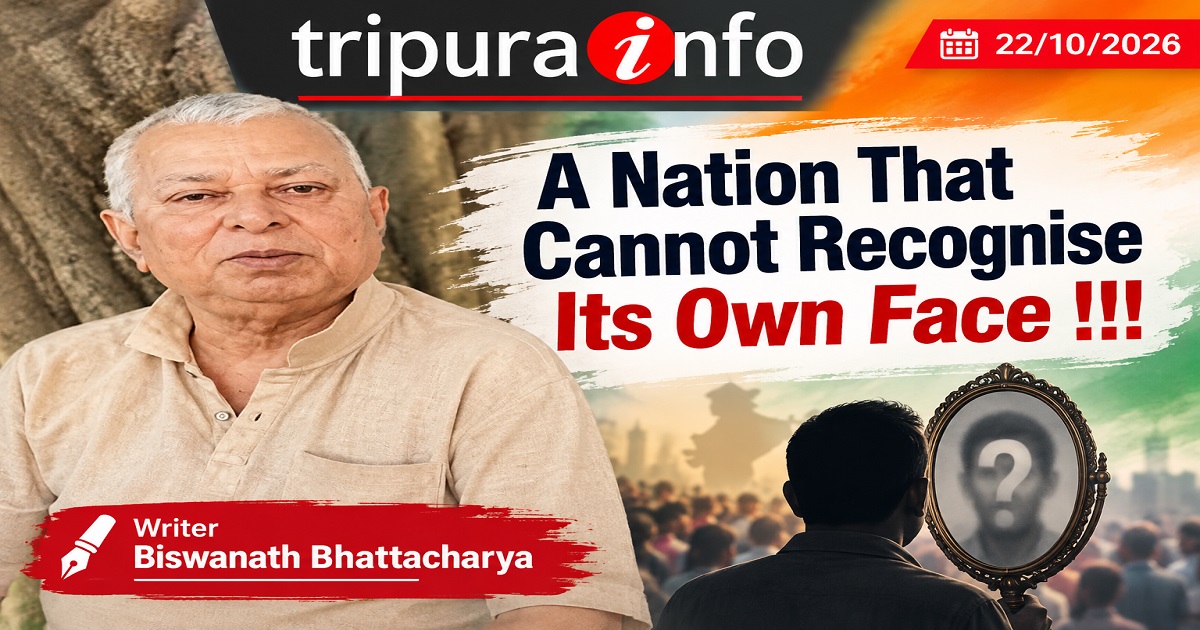
“When a citizen is mocked for the face India gave him, it is not comedy that erupts—it is the bankruptcy of our national education.”
The anger now roaring across Tripura is not the tantrum of a wounded province. It is the eruption of a people exhausted by being stared at, caricatured, misnamed and made to prove—again and again—that their faces, accents and ancestral identities belong to India. For generations, the Northeast has guarded the nation’s frontiers, enriched its culture and carried its flag with fierce loyalty; yet its citizens are still sometimes treated as strangers in the Republic they call home. A widely circulated video allegedly shows Delhi-based content creator Amir Shokeen humiliating a tribal youth from Tripura with racialised remarks, grotesque comparisons and contempt for the state’s name. The allegations remain subject to investigation; the clip must be authenticated, the circumstances established and responsibility fixed by lawful authority.
Yet the public question is already unavoidable. “If humiliation can be scripted for clicks, then prejudice has merely hired a camera.”
The excuse reportedly offered—that the scene was scripted—does not extinguish the ugliness; it pours fuel upon it. A script is not an alibi. It is a declaration of intention. If degrading a person’s ethnicity, appearance or home state is deliberately rehearsed, recorded and released as entertainment, the prejudice is not accidental; it is engineered, packaged and monetised. The victim’s dignity becomes raw material, racism becomes content, and the audience is invited to laugh while the wound is replayed thousands of times. An apology may express regret, but it cannot become a digital eraser, nor can it replace investigation, accountability and preservation of electronic evidence. The law must proceed without mob vengeance, political theatre or selective outrage—and it must proceed with enough speed and seriousness to tell every citizen from the Northeast that the Republic has heard the insult.
Tripura’s anger has crossed party lines because dignity has no party flag. Youth and student bodies have approached the police; leaders from Tipra Motha, the CPI(M) and the Congress have demanded action; Chief Minister Dr Manik Saha has directed the state police leadership to coordinate with Delhi Police; Union Minister Kiren Rijiju has publicly called for punishment; and Delhi Police’s specialised units have reportedly moved to examine the viral material. This convergence is welcome. Racism must never be condemned according to the accused person’s political usefulness. A slur does not become tolerable when uttered by an ally, nor intolerable only when uttered by an opponent.
But arrest demands and FIRs, however necessary where evidence warrants them, confront only the spark. The dry forest is ignorance, and it has been left unattended for decades. Too many Indian children can identify foreign capitals yet cannot place Tripura confidently on a map; they may recite imperial dynasties but know almost nothing of the Manikya kingdom, Unakoti, Neermahal, the Jampui Hills, the bamboo and cane traditions, the languages of the Tiprasa peoples, the Partition-shaped history of the state, or the living cultural bridges connecting Tripura with the rest of India and Bangladesh. The Northeast appears in too many classrooms as a decorative margin: a dance costume, a tea garden, a mountain photograph, a hurried paragraph before the examination ends. This is not a harmless omission. A child omitted from the textbook can later be mocked in the hostel, profiled in the marketplace and treated as foreign on the street. Tokenism is not inclusion. It is erasure printed in colour.
The most powerful long-term answer is curricular justice—and it must be compulsory, examinable and measurable. CBSE, CISCE and every international board operating schools in India should adopt a National Regional Knowledge Framework requiring substantial, separately identifiable coverage of every state and Union Territory from the primary classes through senior secondary school. Tripura and the eight Northeastern states must not be compressed into one ornamental chapter called “the Northeast.” Each state deserves its own accurate intellectual space across history, geography, literature, ecology, constitutional studies, art, music, migration, indigenous knowledge, borderland experience, sport, science and contemporary achievement. This content must carry assessment weight in board-aligned examinations; what is never examined is too easily ignored. Boards should publish grade-wise learning outcomes, minimum instructional hours and annual compliance reports so that inclusion cannot be reduced to a ceremonial page.
The Union Ministry of Education should convene CBSE, CISCE, NCERT, SCERTs and authorised representatives of international boards to complete this framework within a fixed timetable. A Northeast Curriculum Council, with meaningful representation from historians, geographers, indigenous scholars, language experts, teachers, artists and youth from all eight states, should review every lesson before publication. No distant committee should define a people without hearing them. Textbooks and digital modules should include authoritative maps, timelines, pronunciation guides, translated literature, oral histories, biographies, archival photographs, environmental case studies and project work rooted in real communities. Every five years, the material should undergo an independent accuracy and representation audit, with a public mechanism for correcting errors, stereotypes and omissions.
The Tripura Government should not wait at the gates of distant institutions for permission to be known. It should establish a professionally governed Tripura Knowledge Mission with a protected, multi-year budget and a clear mandate to create board-ready books, e-books, multilingual modules, short documentaries, podcasts, virtual museum tours, interactive maps, teachers’ handbooks and open digital archives. Within one academic year, it should prepare graded Tripura learning packs for Classes I to XII in English, Bengali and Kokborok, with further translations for national circulation. Within two years, it should seek formal adoption, supplementary-reader approval or digital-library placement from CBSE, CISCE and leading international boards. Distribution should reach schools, universities, libraries, embassies, cultural centres, Indian missions and Indian schools abroad. Quality must be non-negotiable: tribal voices must speak for themselves; translations must be elegant; names, maps and histories must be exact; propaganda must be excluded; and every resource must be accessible to learners with disabilities and available on low-bandwidth platforms.
Tripurainfo.com offers an instructive example of what sustained civic initiative can achieve when official imagination is slow. Since 2001, it has carried Tripura’s news, knowledge and identity beyond the state; its educational publishing has included year books and study materials on Tripura’s history, geography, culture, economy and public life. The Government should support—not capture—such independent work through transparent grants, competitive commissions, bulk library procurement, translation partnerships, open licensing and guaranteed school access. A public digital repository should host approved resources free of charge, while independent publishers and platforms retain editorial dignity and receive fair compensation. Universities, historians, tribal research bodies, writers, filmmakers, museums, publishers and credible digital platforms should be invited into the mission through published criteria and peer review. Promotion must never become patronage; public money must enlarge knowledge, not manufacture applause.
Government accountability, however, cannot end with a directive, a press conference or a photograph of officials holding a meeting. The Tripura Government must issue a time-bound white paper stating which department will lead this mission, what funds will be committed, which experts will be appointed, when the first materials will appear, and how adoption by national and international boards will be pursued. The Chief Secretary should chair a quarterly review whose minutes, expenditure and missed milestones are published online. The Education Department, Tribal Welfare Department, Information and Cultural Affairs Department and Higher Education Department must have named nodal officers whose responsibilities cannot be dissolved into bureaucratic anonymity. When deadlines are missed, the public deserves written reasons, revised dates and identification of the authority responsible. A promise without a deadline is a slogan; a deadline without named responsibility is camouflage.
The Tripura Legislative Assembly should receive an annual statement on curriculum outreach, expenditure, board engagement, teacher training, digital reach and representation of indigenous communities. A cross-party legislative committee, supported by independent education and tribal-culture experts, should be empowered to summon records, question departmental heads and examine whether public money has produced usable educational content or merely ceremonial events. An independent social audit should measure how many resources were completed, translated, distributed, downloaded and actually used in classrooms. Procurement contracts, selection criteria, expert names, grants and evaluation reports must be publicly accessible, with conflict-of-interest declarations and protection against partisan capture. Any evidence of inflated contracts, plagiarism, exclusion of community voices or diversion of funds should trigger audit, recovery proceedings and action under the applicable service and criminal laws.
Accountability must also extend beyond Tripura. The Union Ministry of Education should publish a national baseline showing how much verified content each board currently provides on every Northeastern state, then report annually on the gaps closed. CBSE, CISCE and international boards operating in India should designate accountable senior officers, disclose implementation calendars and provide a public channel through which states, scholars, schools and communities can challenge factual errors or token representation. If a board claims national reach while repeatedly rendering an entire region invisible, that failure should be recorded in accreditation and affiliation reviews. Inclusion cannot remain optional goodwill exercised by distant textbook committees; it must become an enforceable educational obligation.
Curriculum alone will fail if teachers carry the same blind spots as society. Mandatory pre-service and in-service training should address racial stereotyping involving appearance, accent, food, names and regional identity. School inspections and accreditation reviews should examine whether this material is actually taught. Digital-literacy classes must expose how algorithms reward humiliation, and every school should maintain a confidential, time-bound grievance system for racial harassment. Inter-state classroom partnerships should be funded, not merely praised: a school in Delhi reading Kokborok stories in translation, a school in Agartala studying Ladakhi ecology, a school in Kerala exploring Mizo music, and students visiting one another’s museums, homes and landscapes. Familiarity is not a sentimental ornament. It is preventive civic infrastructure. Ignorance creates the slur; education must remove the soil in which the slur grows.
The present controversy must therefore produce more than outrage that burns for forty-eight hours and then disappears beneath the next trending scandal. First, an impartial investigation must determine what happened, who participated, whether consent was genuine, what was published, who profited, and which legal provisions apply. The investigating authorities should communicate procedural progress within the limits of law so that silence does not breed distrust, while protecting the rights of the complainant and the accused. Second, governments and boards must confront the educational abandonment that allows an Indian face to be treated as foreign inside India. Third, the Tripura Government must place before the public a costed action plan, named implementing agencies, quarterly milestones, audited expenditure and annual outcome targets. Civil society, indigenous organisations, educators and the press must be able to examine that record without filing endless applications merely to discover whether promises were kept. Ministers must answer in the Assembly; officials must answer through published performance reports; boards must answer through measurable curriculum change. Punishment without education may frighten one offender; education without accountability becomes another speech; accountability without consequences becomes another file gathering dust. India needs all three—the firm hand of law, the transforming fire of knowledge and the unforgiving discipline of public scrutiny.
Tripura is not a spelling to be mangled for a laugh. It is not a face to be mocked, a people to be exoticised or a border state to be remembered only when elections, violence or disaster make headlines. It is a civilisation shaped by kings and cultivators, indigenous memory and migration, rivers and ridges, rebellion and reconciliation. The Northeast is not India’s distant corner; it is one of the blazing mirrors in which India must examine the truth of its own unity. If our textbooks leave millions unseen, the street will inherit the blindness of the classroom and social media will sell that blindness as comedy. Let this outrage become more than a volcanic moment of anger. Let it force open syllabi, publishing houses, examination systems, digital platforms and the locked rooms where national memory is edited. Let it create books, lessons, films, archives and human encounters powerful enough to make contempt intellectually indefensible and morally unbearable. A nation does not become united by shouting slogans over the people it has failed to understand. It becomes whole when every child can look upon every other Indian face and say, without hesitation, mockery or condescension: You are not an outsider. Your history is not a footnote. You are part of my country’s story—and my country is incomplete without you.
To the students of India: refuse the lazy joke, the racial nickname and the cruel laughter that turns a classmate’s face, food, language or accent into a target. Ask why Tripura, Mizoram, Nagaland, Meghalaya, Manipur, Arunachal Pradesh, Assam and Sikkim are missing or diminished in your books. Read beyond the prescribed page, challenge stereotypes when they appear, and stand beside the student who is made to feel foreign in his or her own country. Your silence can become permission; your courage can become protection.
To the teachers: do not teach the Northeast as a hurried footnote, a festival costume or a map remembered only for examinations. Bring its histories, literatures, communities, landscapes and contemporary achievements into the living classroom. Correct the slur immediately, pronounce names with respect, question biased material and demand proper resources from schools and boards. A teacher who names prejudice can stop it before it hardens; a teacher who ignores it may unknowingly give it shelter.
To the parents: ask what your children are being taught about the whole of India—and what they are not being taught. Demand inclusive textbooks at parent meetings, question school leaders, support friendships across regions and never allow prejudice to enter the home disguised as humour. Teach children that patriotism is not merely saluting the flag; it is recognising the equal dignity of every citizen who stands beneath it. If students question, teachers illuminate and parents insist, no board, ministry or government will be able to bury this demand beneath another committee report.
The hour for sympathetic statements has passed. Act now. Let the Tripura Government publish its white paper, budget and implementation calendar. Let the Union Ministry of Education summon the boards and set a binding national timetable. Let CBSE, CISCE and every international board in India open their syllabi, count their omissions and correct them. Let legislators demand answers, teachers demand resources, parents demand truthful textbooks, publishers seek authentic voices, journalists follow every promised deadline, and citizens refuse to reward racial humiliation with views, shares or silence. Write to the boards. Question the ministries. Place resolutions before the Assembly. Build the books. Translate the stories. Fund the archives. Train the teachers. Connect the classrooms. Do not allow this fire to be smothered by the next headline.
Tripura must rise—not to ask for charity, but to demand recognition; not to plead for a paragraph, but to claim its rightful pages in the story of India. The Northeast must be taught, read, heard and known. And until every Indian classroom recognises every Indian face, none of us has the moral right to declare the work of national unity complete. This is the moment to turn anger into curriculum, insult into institution, protest into policy and memory into power. Let the Republic answer—not with another promise, but with action visible in every textbook, every school and every child.
(Tripurainfo)
more articles...