THE TRICOLOUR : INDIA'S CONSTITUTIONAL VISION AND NATIONAL IDENTITY
DR. SUMON ALI
July 22, 2026
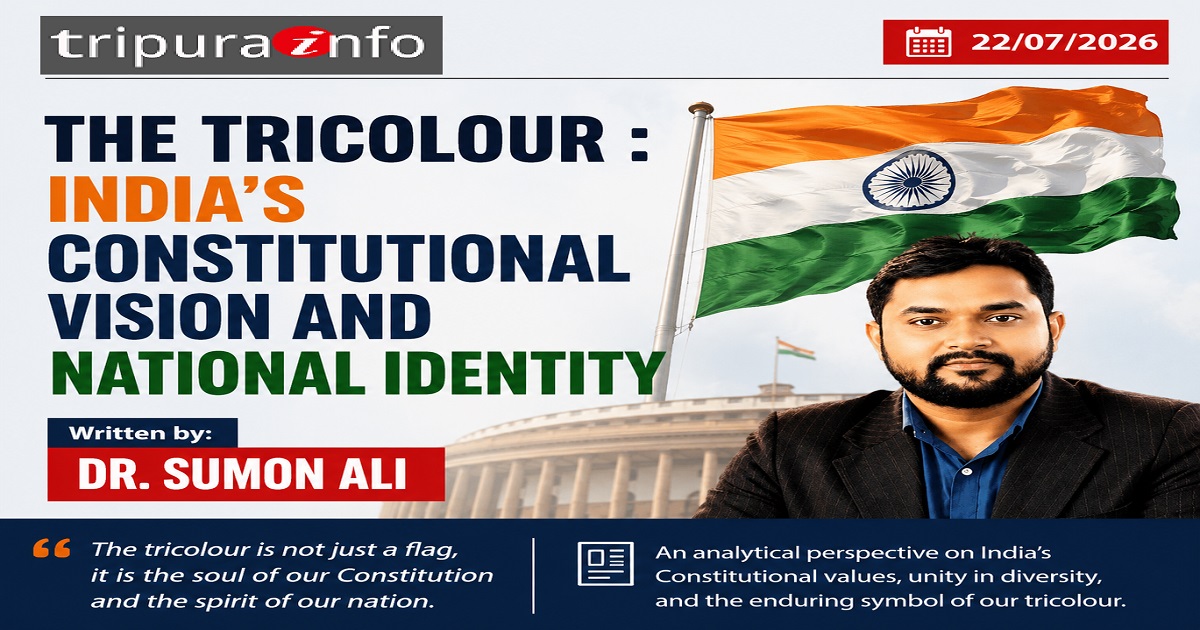
22 July 1947. Just twenty-three days before India attained independence, the Constituent Assembly in New Delhi adopted a decision that gave shape not merely to a flag, but to the identity of a newborn nation. On that day, India adopted the Tricolour as its National Flag. Yet, the history of the Tricolour did not begin on that day. Behind it lay more than four decades of struggle, reflection, and sacrifice. Even before the birth of the Republic, the nation's identity had been given a visible symbol. While India emerged as an independent state on 15 August, it was on 22 July that the nation presented its national soul to the world through a symbol.
The Origin of the Idea of a National Flag:
During the closing decades of the nineteenth century and the beginning of the twentieth century, the desire for freedom from British colonial rule steadily intensified. As people of different languages, religions, ethnicities, and cultures united under the cause of independence, the need for a common national symbol became increasingly evident. Just as national flags had come to represent unity and sovereignty in many European countries, the leaders of India's freedom movement realised that an all-India national flag would play a vital role in uniting and strengthening the struggle for independence.
Among the earliest notable efforts was the flag proposed by Sister Nivedita, a disciple of Swami Vivekananda. Around 1904, she designed a red and yellow flag bearing the Vajra (thunderbolt) and the words “Vande Mataram,” symbolising India's strength, self-respect, and cultural renaissance. Although this design never received official recognition, it clearly articulated the concept of a national flag.
The next milestone came on 7 August 1906, when the first tricolour flag was hoisted at Parsee Bagan in Calcutta, marking a significant moment in the history of Indian nationalism. The following year, in 1907, Madam Bhikaji Cama unfurled the Indian flag at the International Socialist Conference in Stuttgart, Germany, bringing India's demand for independence before the world. Later, during the Home Rule Movement of 1917, the flag used by Annie Besant and Bal Gangadhar Tilak added a new dimension to the evolution of the national flag as a symbol of self-government.
The most important chapter in this continuing journey was written in 1921, when Pingali Venkayya, a patriot and researcher from Andhra Pradesh, presented a new flag design to Mahatma Gandhi during the session of the Indian National Congress at Vijayawada. At Gandhi's suggestion, a white stripe and the spinning wheel (charkha) were added, symbolising truth, unity, self-reliance, and the ideals of the Swadeshi Movement. Through several modifications and refinements, this design ultimately laid the foundation of independent India's National Flag, the Tricolour.
The Birth of the Tricolour, the Constituent Assembly Debate:
Although the flag proposed by Pingali Venkayya in 1921 became one of the foremost symbols of the freedom movement, it had not yet become India's official National Flag. During the following decade, political realities changed, and so did the philosophy behind the flag. Transforming the symbol of a political movement into the universally accepted emblem of an independent nation required fresh thinking. The year 1931 marked a turning point in the history of India's National Flag. The Indian National Congress appointed a special committee to decide the issue of the flag. After extensive deliberations, it adopted a tricolour consisting of saffron at the top, white in the middle, and green at the bottom, with the charkha placed at the centre. This decision carried profound significance.
First, the Congress explicitly declared that the colours of the flag did not represent any religious community. Earlier, there had been attempts to associate red, green, and other colours with Hindu or Muslim communities. The 1931 decision firmly rejected such interpretations.
Second, the charkha was presented not merely as a symbol of economic self-reliance but also as the moral foundation of India's struggle for freedom. The flag adopted in 1931 became the direct predecessor of the National Flag of independent India.
When independence became certain in 1947, the most important question was: What should be the National Flag of independent India? Should the Congress flag be retained, or should a new flag representing the entire nation be adopted? The Ad Hoc Flag Committee concluded that the National Flag should not carry the symbol of any political party. Consequently, the Ashoka Chakra, representing India's ancient civilisation, morality, and philosophy of governance, replaced the charkha.
Although Pingali Venkayya is the name most closely associated with the history of India's National Flag, the contribution of Surayya Badruddin Tyabji in giving the flag its final form deserves equal recognition. She was a distinguished artist and designer and the wife of Badruddin Tyabji, an officer of the Indian Civil Service (ICS). Historical research, documents preserved by the Tyabji family, and scholarly analyses indicate that she played a significant role in preparing the final artwork of independent India's National Flag. In particular, several studies acknowledge her creative contribution in replacing the charkha with the Dharma Chakra adopted from the Lion Capital of Ashoka at Sarnath and in preparing the final artistic design of the flag in a balanced and aesthetically refined manner.
However, a historical clarification is necessary. The official proceedings of the Constituent Assembly on 22 July 1947 do not mention either Pingali Venkayya or Surayya Tyabji as the "designer" of the National Flag. Therefore, it is more historically accurate to state that Surayya Tyabji made a significant creative contribution to the final form of the National Flag of independent India. Justice to history requires acknowledging all four pillars together: Pingali Venkayya's original design, Mahatma Gandhi's vision, the Congress decision of 1931, and Surayya Tyabji's artistic contribution.
The Historic Session of the Constituent Assembly:
On 22 July 1947, in the Constituent Assembly at New Delhi, Jawaharlal Nehru moved the resolution for the adoption of the National Flag of independent India. His speech was an extraordinary blend of emotion, history, and vision for the future nation. Nehru declared that the flag was not a symbol of imperial conquest but a symbol of freedom. He reminded the Assembly that countless freedom fighters had marched under this flag, endured imprisonment, suffered lathi charges, and many had sacrificed their lives. To honour the Tricolour, therefore, was to honour their sacrifice. One of the most significant themes of Nehru's speech was that the flag belonged to no religion, caste, or community. It belonged to every citizen of India. During the debate, Dr. Sarvepalli Radhakrishnan offered a profound philosophical interpretation of the colours of the flag and the Ashoka Chakra, an interpretation that continues to be regarded as the most authoritative. His explanation later came to be recognised as the philosophical foundation of India's National Flag.
Several members of the Constituent Assembly supported Nehru's resolution. H. V. Kamath spoke of the deep emotional attachment of the people to the flag and described it as the symbol of the collective identity of independent India. Frank Anthony, representing the Anglo-Indian community, declared that every citizen of India would enjoy equal dignity under this flag. Syed Mohammad Saadulla welcomed it as a national symbol that transcended religious divisions. Seth Govind Das highlighted its connection with India's cultural heritage and the struggle for independence.
Significantly, after extensive deliberations, the resolution adopting the National Flag was accepted virtually unanimously. The decision taken on 22 July 1947 conferred constitutional status upon the Tricolour of India. When it was officially hoisted over independent India for the first time on 15 August 1947, it represented not merely a design, but the culmination of decades of struggle, the sacrifice of countless people, and the historic consensus of the Constituent Assembly.
The Constitution, the Tricolour, and the Indian Philosophy of the State
Although the Constituent Assembly adopted the National Flag on 22 July 1947, the true philosophy of the Indian state acquired its constitutional form on 26 January 1950, when the Constitution came into force. These two historic moments are deeply interconnected. The National Flag is the visible symbol of the state, while the Constitution is its moral and legal foundation. Therefore, the most meaningful way to understand the Tricolour is to interpret it in the light of the Constitution.
For many years, various interpretations of the colours of the National Flag were prevalent. Before independence, many attempted to associate the saffron, white, and green colours with different religious communities. However, in the Constituent Assembly, Jawaharlal Nehru and Dr. Sarvepalli Radhakrishnan made it clear that such interpretations were unacceptable. The National Flag of India does not represent any religion, caste, or community; it represents the entire nation.
Saffron (Kesari) symbolises sacrifice, courage, selflessness, and moral leadership. State power is not a means of personal enjoyment; it is a sacred responsibility towards the people. Thus, the saffron colour reminds those who govern that the true dignity of power lies in public service.
White symbolises truth, peace, transparency, and morality. Constitutional governance, the rule of law, an impartial judiciary, and a culture of democratic tolerance are founded upon these values. White teaches us that democracy cannot survive without truth and justice.
Green symbolises life, hope, agriculture, the environment, productivity, and sustainable development. It represents India's commitment, after independence, to economic development, food security, and environmental protection.
At the centre of the Tricolour lies the navy blue Ashoka Chakra, the most significant element of India's National Flag. The philosophy of the Indian state is founded not upon a static tradition but upon the creation of a dynamic, democratic, and just society.
The Preamble to the Constitution of India gives special importance to four fundamental ideals: Justice, Liberty, Equality, and Fraternity. These words do not appear anywhere on the National Flag. Yet, the symbolism of the Tricolour gives visible expression to these very ideals. In this sense, the Tricolour is a visual interpretation of the Preamble to the Constitution.
According to Article 51A(a) of the Constitution, it is the fundamental duty of every citizen to respect the Constitution, the National Flag, and the National Anthem. The significance of this duty extends far beyond ceremonial observance. Genuine respect for the National Flag is demonstrated only when citizens embody the ideals of the Constitution in their daily lives. Opposing corruption, preserving social harmony, practising religious tolerance, protecting the environment, ensuring gender equality, and upholding democratic values are all expressions of true respect for the National Flag. In other words, to honour the Tricolour is to honour the spirit of the Constitution.
For many years after independence, the use of the National Flag remained under strict governmental regulation. Ordinary citizens did not enjoy the right to hoist the National Flag on a daily basis. This situation changed through the initiative of industrialist Naveen Jindal, who argued that flying the National Flag was a citizen's constitutional right to express patriotism. In the landmark case of Naveen Jindal v. Union of India (2004), the Supreme Court of India held that flying the National Flag forms part of the freedom of expression guaranteed under Article 19(1)(a) of the Constitution, provided it is done in accordance with the law and the provisions of the Flag Code of India. This judgment brought the National Flag much closer to the people. Subsequently, important amendments were introduced in 2021 and 2022, permitting, under specified conditions, the hoisting of the National Flag both day and night and expanding the use of flags made from different materials, whether handmade or machine-made.
Indian nationalism has been interpreted in various ways. Some describe it as cultural nationalism, others as political nationalism, while still others regard it as civilisational nationalism. However, the conception of nationhood established by the Constitution of India is founded upon constitutional nationalism. In this understanding, the identity of a citizen is determined not by religion, language, or ethnicity, but by allegiance to the Constitution, the rule of law, democratic values, and equal rights. The Tricolour is the most powerful visible symbol of this constitutional nationalism.
The Significance of the Tricolour in Contemporary India
The true value of a flag becomes evident when a nation faces moments of crisis. Whether on the battlefield, during natural disasters, in international sporting arenas, or at moments of scientific achievement, the Indian Tricolour proclaims not merely the presence of a state but the identity of a pluralistic, democratic, and constitutional nation before the world.
India today is advancing through a period of rapid transformation. At the same time, concerns have emerged regarding religious polarisation, social divisions, and the spread of misinformation, hate speech, environmental challenges, and the practice of democratic values. In this context, the significance of the Tricolour becomes even more profound. It reminds us that India's strength lies not in uniformity but in unity in diversity. The Constitution embodies this very philosophy.
In recent years, the 'Har Ghar Tiranga' initiative has significantly increased public interest and participation in honouring the National Flag. Particularly when the younger generation commits itself to honesty, harmony, equality, environmental responsibility, and the rule of law instead of corruption, discrimination, and hatred, genuine respect for the Tricolour is demonstrated. A great nation becomes great not only through economic strength but also through the character and values of its citizens.
To Conclude, Rabindranath Tagore wrote: “Where the mind is without fear and the head is held high.” The India of that dream cannot be fulfilled merely through political independence. Its fulfilment comes only when the symbols of the state find a place in the moral consciousness of its people. Every colour of the Tricolour and the Ashoka Chakra embodies the constitutional ideals of Justice, Liberty, Equality, and Fraternity. The true dignity of the Tricolour, adopted by the Constituent Assembly as the National Flag of India, will be preserved only when we cherish not merely the flag itself but also the constitutional ideals that it represents. A flag may fly in the sky through the power of the state, but it flies in the hearts of the people only through the power of values. For that reason, the Tricolour is not merely the National Flag of India; it is a memorial to freedom, the visible language of the Constitution, and the enduring identity of a democratic nation. (DR. SUMON ALI, Guest
Faculty, Department of Political Science, Tripura University.)
(Tripurainfo)
more articles...