Tackling Relative Deprivation
Dr Sanjay Kumar Panda IAS (Retd)
September 23, 2026
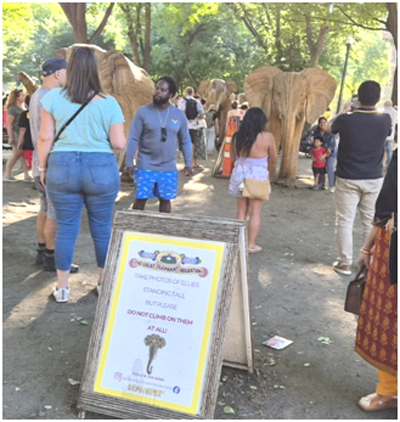
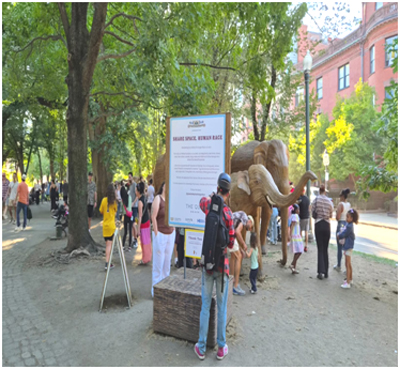
On
the 14th September 2026, I had the opportunity of visiting the
elephant show in The Mall, Commonwealth Avenue Park, Boston, USA with family,
where one hundred elephants made of cane were on display. Description of the
show, read as follows, made me proud and nostalgic.
"Each
scripture is a faithful replica of a real wild elephant, known by a name and
personality to the people of the Nilgiris Hills in southern India, where elephants
and people share one of the world's most densely populated landscape.
Created
by indigenous artisans of The Real Elephant Creative- Betta Karumba,
Paniya, Kattunayakun and Saliga- the herd carries a simple idea.
Across much of India, animals are not seen as threats to be removed but as
fellow lives to be respected.
These
elephants are a love letter from a culture that has never forgotten how to share the world."
The
show attracted huge crowds and was of curiosity to the younger age group. The
elephants were available for private acquisition, at rates varying from 10,000
to 22,000 US dollars per elephant depending on the size and shape. The show was
on move to various parts of America.
This
visit made me recall my Tripura days and prompted me to share my experience as
a way of giving back to the people of the state, whom I feel deeply indebted.
After
reaching Tripura in June 1981, my official introduction to the state had a few
common phrases, namely (i) 73 percent people live below poverty line, (ii) Geographical
isolation, bounded by Bangladesh on three sides, (iii) Limitation of physical
infrastructure in terms of rail, road connectivity, (iv) Limited financial
resources and (v) Insurgency related adverse law and order conditions. These issues
dominated our official interactions in all forums including with the Government
of India.
 It
is very satisfying that by the time I left Tripura in July 2014 for central
deputation, the situation had changed dramatically. Much talked about
insurgency was under control, making Tripura as peaceful as any other state of
the country. Subsequently, broad gauging of railway lines in 2016 and widening of
the National Highway improved connectivity to a remarkable extent. Position of state’s
financial position and incidence of absolute poverty also improved
significantly. Subsequently, General elections in 2018 brought about changes in
terms of enhanced central support and growth of private sector.
It
is very satisfying that by the time I left Tripura in July 2014 for central
deputation, the situation had changed dramatically. Much talked about
insurgency was under control, making Tripura as peaceful as any other state of
the country. Subsequently, broad gauging of railway lines in 2016 and widening of
the National Highway improved connectivity to a remarkable extent. Position of state’s
financial position and incidence of absolute poverty also improved
significantly. Subsequently, General elections in 2018 brought about changes in
terms of enhanced central support and growth of private sector.
However,
unemployment and relative deprivation continue to be matters of concern. These two
issues are interrelated and tackling those need a change in thinking and
approach.
Given
the historical prospective and geographical isolation, prevailing mindset for secured livelihood is too obvious. This has
led to the deep-rooted desire for salaried
employment under government and
other public organizations. In the 21st century, the limitation of providing
employment under government is too well known to be elaborated.
However,
appreciating and acting on it is a slow process. In this context, the educated,
intelligentsia, civil society organization as well as print and electronic
media have a role in encouraging private initiatives for generating employment,
irrespective of size and nature.
My
present writeup is a step in that direction
It aimed
at enlightening the youth about the existing and emerging opportunities in the
private sector within the country and abroad as well as the prerequisites for its
exploitation. In
view of location in the northeastern region, land-based activities will
continue to be important in creating employment and wealth for the masses.
The economic
policy of 1991, based on liberalization, privatization and globalization, has
brought about significant economic development making India one of the major global
economic powers, surpassing its colonial master United Kingdom, as well as Japan
and Germany. However, it is necessary to read in between the lines to
understand the nuisance of the 1991 policy about social and equity aspects and
impact on the disadvantaged.
 Among
products of Tripura, which are appreciated outside, cane and bamboo handicrafts
have a unique place. Super design, skill of the artisans, both women and men,
make it a must in the purchase list of tourists visiting Tripura. The peacock made
from split bamboo, the face of Durgamata as well as the bamboo mats for the
dining table are pride possessions.
Among
products of Tripura, which are appreciated outside, cane and bamboo handicrafts
have a unique place. Super design, skill of the artisans, both women and men,
make it a must in the purchase list of tourists visiting Tripura. The peacock made
from split bamboo, the face of Durgamata as well as the bamboo mats for the
dining table are pride possessions.
I
had the opportunity of working with the cane and bamboo artisans of the state
for decades. Several initiatives were taken to diversify and make new products
with help from the central Bamboo and Cane Development Institute (BCDI), engagement
of Ms. Chelana Desai, a Mumbai based designer, and encouraging talented faculty
and students of the Tripura Arts College. The startup, launched by the young art
graduate couple, Shanta and Mantosh Debnath at Paschim Noabadi on the GB Hospital-Banikya Chowmani
Road, had a good response from the art loving customers. However, transport
outside the state and fear of insurgency posed major constraints, which have
been effectively controlled.
My
recent visit to the elephant shows in Boston, as described above, reminded me
of the artistic craftsmen of Tripura. The cost of one cane elephant was over
10,000 US dollar, corresponding to about 9,00,000 Indian rupees, which is a good
amount even after deduction of the packing, transport, insurance, and other
related expenses. This indicates the potential for generations of wealth and
employment through cane and bamboo handicrafts based decorative products for
art-loving wealthy people living across the globe.
Exploiting
this potential will require consolidating the efforts of the past with
-
Generating
interest about the skill, techniques, art, and culture, of the products along
with storytelling among the consumers by using “Digital India” led,
mobile based social media like YouTube and WhatsApp.
-
Encouraging
and supporting private entrepreneurs to work in coordination with the producer
groups for undertaking production and sale with quality control, time, and efficient
supply chain management.
-
Developing
new and contemporary design, and new products by the creative local youth and
availing support of Artificial Intelligence (AI).
-
Availing
broad-gauge railway line facility for bulk transport to port/ airports.
-
Pooling
resources under ongoing programs for promotion of arts, culture, and exports.
Looking
back on my days spent in Tripura, it is very satisfying to see the development
and progress on various fronts. However, innovative technology coming up at
frequent intervals has widened the relative deprivation between the rich and
the poor. The affluent segment has been using technology and going up the
economic ladder faster than the underprivileged, which is further widening the relative
deprivation. This issue needs practical solutions to be addressed in a pragmatic
manner.
I am optimistic that the peace-loving
people of Tripura with passion for art and crafts will work on a new strategy
for exploiting potential of bamboo and cane handicraft on a path for high value
and high-volume production and marketing outside the state. This will open a
new chapter of inclusive growth, making the economic journey distributive with prosperity
for all - "Sabka Sath and Sabaka Vikash"
[i] Note: With a view to giving back to society, SHRADDHA, NGO is working to
promote handloom and handicraft increasing earnings of the weavers/ artisans.
It has been a very satisfying experience. For details, interested persons may
please visit website https://www.shraddha-handloom.com/
Writer: (Dr Sanjay Kumar Panda IAS (Retd), Former Chief
Secretary, Tripura [email protected])
(Tripurainfo)
more articles...