Netaji and the Moral Meaning of Nationalism
Inu Adhikari
January 23, 2026
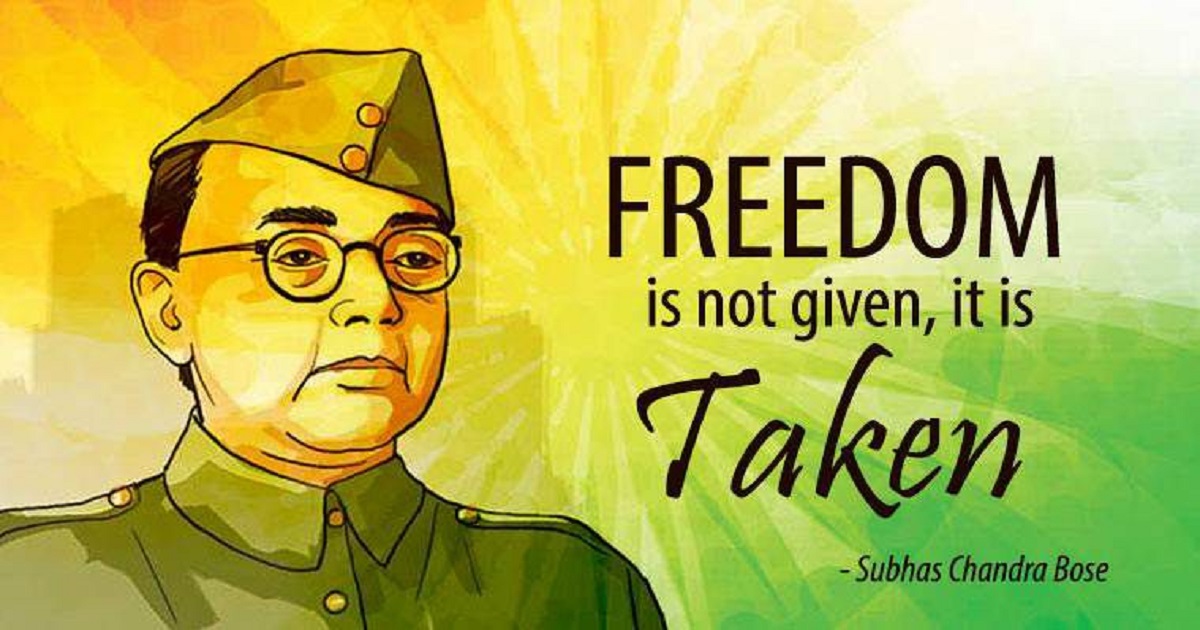
January 23—the birth anniversary of Netaji Subhas Chandra Bose, observed as Parakram Diwas—is no longer merely a date of ceremonial remembrance. It has emerged as a deeply political moment that urges India to confront its national conscience. We mark this day at a time when the language of nationalism is increasingly shaped by obedience, loyalty tests, and the politics of division. In this context, Netaji’s life and ideas raise an urgent and unsettling question: is nationalism meant to be the language of power, or the expression of ethical responsibility and moral courage? Parakram Diwas does not ask us only to honour past bravery—it demands the courage to question the politics of the present.
If nationalism no longer allows questions, dissent, or moral responsibility, then what exactly are we being asked to celebrate in its name?
In today’s India, nationalism is no longer merely the instinctive language of love for one’s country; it is being steadily refashioned into an instrument of political control. Emotion, identity, and loyalty are carefully fused to produce a version of patriotism in which questioning appears suspicious and disagreement sounds disloyal. The moral meaning of devotion to the nation is quietly giving way to a politics of obedience, as the citizen is reduced to the compliant subject. This is not a temporary distortion but a structural transformation, exerting a slow yet relentless pressure on the democratic conscience of the republic—so that when nationalism stops speaking in the language of ethics and begins speaking in the language of authority, democracy itself enters a zone of quiet danger. It is precisely at this moment that the life and thought of Netaji Subhas Chandra Bose return with unsettling force: a leader who, at the height of British imperial power in 1921, abandoned the Indian Civil Service in favour of principle over privilege, declaring through action that freedom cannot be built on comfort, only on conviction. His words in An Indian Pilgrim—“My faith in the destiny of India is firm”—capture the soul of his nationalism, rooted not in domination but in moral confidence in a just future, and they hold up a demanding mirror to our times, compelling us to choose between a nation bound by fear and enforced loyalty and a society sustained by the courage to uphold unity through difference.
Netaji’s Moral Nationalism
Netaji’s nationalism was never an emotional outburst of blind patriotism; it was a coherent political philosophy grounded in ethics, reason, and historical realism. For him, the nation was not merely a territory or a collection of cultural symbols—it was a moral community, sustained by the shared sense of responsibility among its citizens. This vision stands in fundamental opposition to contemporary state-centric nationalism, which often seeks to imprison the nation within rigid structures of enforced loyalty. Though inspired by the European ideals of freedom and self-determination, Netaji never ignored India’s plural social reality. He clearly understood that in a society as diverse as India, nationalism must be inclusive or it would inevitably become a pathway to division rather than unity. At the heart of his thought lay a philosophy of moral struggle: freedom, he believed, was not simply the capture of political power, but the building of national character itself. This conviction found powerful expression in The Indian Struggle (1920–1942) when he wrote, “India cannot achieve her freedom without intense struggle, sacrifice and suffering.” In this single sentence lies the philosophical spine of his nationalism—liberation is not born from emotional frenzy, but from ethical firmness and self-sacrifice. Netaji thus elevated nationalism from the realm of sentiment to the sphere of moral duty, where citizens are not obedient subjects, but active ethical partners in the making of a just nation.
The Constitution’s Preamble and Netaji: Two Expressions of the Same Moral Imagination
The Preamble of the Indian Constitution is not merely a legal declaration; it is the moral map of independent India’s identity. Dr B. R. Ambedkar himself warned that a constitution is not only a body of laws, but the ethical conscience of a society. Remarkably, long before this moral map was formally written, Netaji Subhas Chandra Bose had already given political expression to the same ethical imagination in the public arena. What we now recognise constitutionally as justice, liberty, equality, and fraternity existed in Netaji’s politics as a living philosophy. For him, the nation was not an administrative machine or a structure of power; it was a moral community built upon justice. This is why he wrote in The Indian Struggle, “The real strength of a nation lies in the unity of its people.” This was not a rhetorical call for unity, but a complete philosophy of the state—one in which national strength flows not from weapons, state authority, or numerical dominance, but from moral cohesion. It is at this precise point that Netaji’s vision and the Constitution’s Preamble converge: both sought to anchor India’s future not in the politics of force, but in the imagination of an ethical republic.
Nation vs Government: A Forgotten but Vital Distinction
One of the deepest roots of India’s contemporary nationalist crisis lies in the deliberate erasure of a vital democratic boundary—the difference between the nation and the government. When a ruling regime projects itself as the sole embodiment of the nation, criticism of the state is swiftly recast as hostility towards the country itself. What once appeared as confusion has now hardened into political method. From this point onward, nationalism stops being the language of civic responsibility and becomes an instrument of power. Yet political philosophy is unambiguous: a nation grows from shared history, collective memory, and moral aspiration, while a government remains only a temporary structure of administration. When this line is blurred, citizenship shrinks into obedience and nationalism degenerates into a loyalty test. This is why Article 19(1)(a) of the Constitution is not a technical provision but a democratic lifeline—the right to criticise the government is not anti-nationalism, but the highest expression of responsible citizenship. India’s freedom struggle itself confirms this truth: resistance to the British government was never resistance to India. No one grasped this more clearly than Netaji Subhas Chandra Bose. Unyielding against colonial authority yet unwavering in national unity, his life proved that opposing a government can be the deepest form of loyalty to the nation. His nationalism never demanded blind obedience; it was built on conscious citizenship and moral responsibility. That is why he endures not merely as a leader of the past, but as a foundational thinker of democratic nationalism today—reminding us that governments are never above scrutiny and nations are never created by administrative orders, for, as he so powerfully declared, “A nation is not merely a territory or a government; it is an idea, a moral force that lives in the hearts of its people.”
Strategy vs Ideology: The Netaji–Hitler Meeting and Political Realism
One of the most persistently distorted episodes of Netaji Subhas Chandra Bose’s life is his 1943 meeting with Adolf Hitler, often misrepresented as evidence of ideological proximity. This reading is not history but motivated simplification. In reality, the contact was a strategic attempt to secure international support against British imperialism, not an endorsement of Nazi doctrine. Operating within the harsh constraints of colonial geopolitics, Netaji engaged with state powers, but such engagement never defined the moral foundations of his nationalism. Hitler’s nationalism was racial, exclusionary, and authoritarian—rooted in blood, ethnic purity, and state domination—whereas Netaji’s nationalism was inclusive, secular, and ethical, grounded in the collective will and freedom of the people. He consistently affirmed that independent India must rest upon democracy and equal rights, principles fundamentally incompatible with fascist state ideology. To confuse tactical diplomacy with ideological surrender is therefore to misunderstand Netaji’s politics entirely. For him, the ultimate objective was never the power of the state, but the moral liberation of the nation—a distinction that remains crucial today, as the tendency to equate state power with national identity continues to convert nationalism from an ethical responsibility into a language of dominance.
Dissent and Nationalism: Netaji’s Democratic Test
For Netaji Subhas Chandra Bose, nationalism was never a demand for silent obedience but a test of democratic courage. At a time when unity is often equated with conformity, he insisted that true national strength lies in the ability to move forward together despite principled disagreement. This conviction was most powerfully demonstrated in 1939, when, despite commanding a majority as Congress President, he resigned rather than fracture the organisation, proving that principles matter more than power. Even in dissent, he refused the politics of disruption, choosing instead to build the Forward Bloc as a constitutional alternative, showing that disagreement can renew rather than weaken democracy. Netaji thus transformed dissent from a threat into a civic virtue—the intellectual lifeblood of a nation. This is why he declared, “Freedom is not merely political freedom; it is the freedom of the mind and soul,” placing freedom of thought at the ethical core of nationalism. In an age when questioning is increasingly viewed with suspicion, his life confronts us with a stark choice: is national unity forged through obedient silence, or through reasoned criticism and civic courage? History leaves little doubt—nations that suppress dissent ultimately extinguish their own democratic strength.
The Indian National Army: Nationalism in Inclusive Practice
Had Netaji’s nationalism remained confined to speeches, it might today survive only as a noble memory; instead, through the reorganisation of the Indian National Army in 1943, he carried his ideas into history itself. The INA was not merely a fighting force but a moral experiment in nation-building, where the only identity that mattered rose above religion, language, region, and background—commitment to freedom. Hindu, Muslim, Sikh, and Christian soldiers were bound by a common oath, where faith remained personal but national duty supreme. This inclusive spirit lived on in “Jai Hind,” a greeting meant for all Indians, not one community, and in the Rani of Jhansi Regiment, which brought women into equal partnership in struggle. Netaji’s belief that unity grows from harmony in diversity was thus not a slogan but a lived reality—forcing us to ask why, if pluralism could bind a nation in war, peacetime politics so easily abandons it.
Secularism: Not a Constitutional Word, but the Moral Spine of Politics
In Netaji Subhas Chandra Bose’s political philosophy, secularism was neither a tactical compromise nor a decorative legal principle; it was the ethical foundation of statecraft itself. The word “secular” entered the Constitution only in 1976, yet long before that Netaji understood that in a multi-religious society like India, the state cannot remain united unless it remains secular. This conviction led him to declare with unmistakable clarity, “Religion is a personal matter. It must not be mixed with politics.” This was not diplomatic balancing, but a firm assertion of modern statehood. His concern was deeply political: once religion becomes a test of state loyalty, citizenship degenerates into a politics of numbers, and democracy is reduced from a moral ideal to a competition for power. He translated this principle into practice in 1943 while reorganising the Indian National Army, binding Hindu, Muslim, Sikh, and Christian soldiers under the same oath to demonstrate that national unity rests on civic duty, not religious identity. Today, although secularism is constitutionally inscribed, its moral vitality is steadily eroding in political discourse and social conduct, exposing the widening gap between ethical secularism and political secularism. History is unambiguous: where religion becomes an instrument of politics, democracy weakens; where faith is respected as a personal belief, national unity is strengthened.
The Contemporary Politics of Division: A Critical Reading
In present-day India, political polarisation is no longer a spontaneous social reaction but a carefully engineered strategy of power, where religion, identity, language, and culture are systematically turned into political instruments. What once lingered at the margins now occupies the centre of public discourse—shaping election campaigns, television debates, and even social media algorithms—so that the very process of opinion formation is transformed into a machinery of division. National unity is no longer upheld as an ethical ideal of coexistence; instead, it is being forced into a narrow cultural mould in which diversity appears not as a social reality but as a political suspicion. The constant reproduction of the “us versus them” divide is not only fragmenting society but steadily weakening the social foundations of democracy. Most dangerously, this politics reshapes nationalism from a language of moral responsibility into a weapon of power, using restrictive definitions of “national interest” and “patriotism” to push difference and dissent into the shadow of disloyalty. In this climate, Netaji’s inclusive nationalism confronts us with an uncomfortable but necessary question: are we building an India where unity is imposed by suppressing difference, or a society where unity is sustained by the moral courage to coexist?
Netaji’s Contemporary Relevance
Remembering Netaji in today’s India is no longer a ritual homage to the past; it is a stern moral interrogation of the present. We live in a moment when patriotism is steadily abandoning the language of conscience and turning into a test of obedience. Against this backdrop, Netaji’s nationalism offers an alternative imagination of the state—where the nation is not an extension of a single identity, but a living community built upon equal rights, civic responsibility, and moral courage. History shows that this was not mere theory. The nationwide mobilisation around the INA trials in 1945, when Hindus, Muslims, and Sikhs spoke in one voice against colonial courts, and the subsequent tremors within the British armed forces culminating in the 1946 naval revolt, reveal that Netaji’s nationalism was not an emotional wave but a moral force capable of shaking imperial state structures themselves. At a time when dissent is increasingly branded as discomforting, Netaji reminds us that democracy is not only about elections, but about a culture of courageous citizenship. It is for this reason that he rises beyond the pages of history to become the conscience of our age—persistently asking whether we are building a nation grounded in fearful obedience or a democratic society sustained by moral courage.
Parakram: Not the Power of Force, but the Courage of Conscience
To reduce Netaji to the romantic image of a warrior is to commit the gravest injustice to his legacy, for his idea of parakram was never confined to courage on the battlefield—it was courage of character. It was the strength to stand upright before injustice, the wisdom to build unity amid difference, and the moral capacity to place national duty above personal comfort. Netaji knew that the real power of a nation does not lie in the barrel of a gun, but in the conscience of its citizens. His nationalism was therefore not an eruption of emotion, but a discipline of values, where patriotism meant not blind loyalty, but active commitment to justice, reason, and responsibility. This is why his faith in the youth carried such depth: “The future of India depends on her youth,” for he saw young citizens not merely as strong arms, but as bearers of moral leadership upon whose character the nation’s destiny rests. Even his famous call—“Give me blood, and I will give you freedom”—so often misread as a war cry, was in truth a civic pledge, in which “blood” meant not only life but responsibility, a reminder that freedom is not granted but earned, and earned not by weapons, but by character. The true meaning of Parakram Diwas, then, is not ceremonial homage but ruthless self-examination: whether we will continue to use nationalism as the language of force, or rebuild it as a moral responsibility—because history is unforgiving to nations that lose moral courage, for they do not merely forfeit their past glory, they surrender their future itself.
Netaji’s parakram teaches us that a nation truly moves forward when moral courage rises above the display of power, and when no one loses the courage to stand for humanity in the face of fear-driven politics.
{Author: Inu Adhikari, PhD Scholar, Department of Political Science, Dhamma Dipa International Buddhist University (DDIBU)}
(Tripurainfo)
more articles...