New Gateway to Southeast Asia: Will Tripura’s 'Maitri Setu' Transform the Future of Northeast India?
Jayanta Debnath
March 13, 2026
For decades, India’s Northeast was often perceived as a remote frontier region, geographically distant from the country’s main economic centers. However, in recent years, international and national policy experts have increasingly begun to view the region in a different light. Many economists, strategic analysts, business leaders and journalists now believe that within the next decade, Northeast India could emerge as one of the fastest-growing economic regions in the country.
This optimistic outlook is based on several factors: the region’s strategic geographical location, its proximity to multiple international borders, rich natural resources, and the rapid expansion of infrastructure projects. Together, these developments are gradually transforming the Northeast from a peripheral territory into a potential gateway connecting South Asia with Southeast Asia.
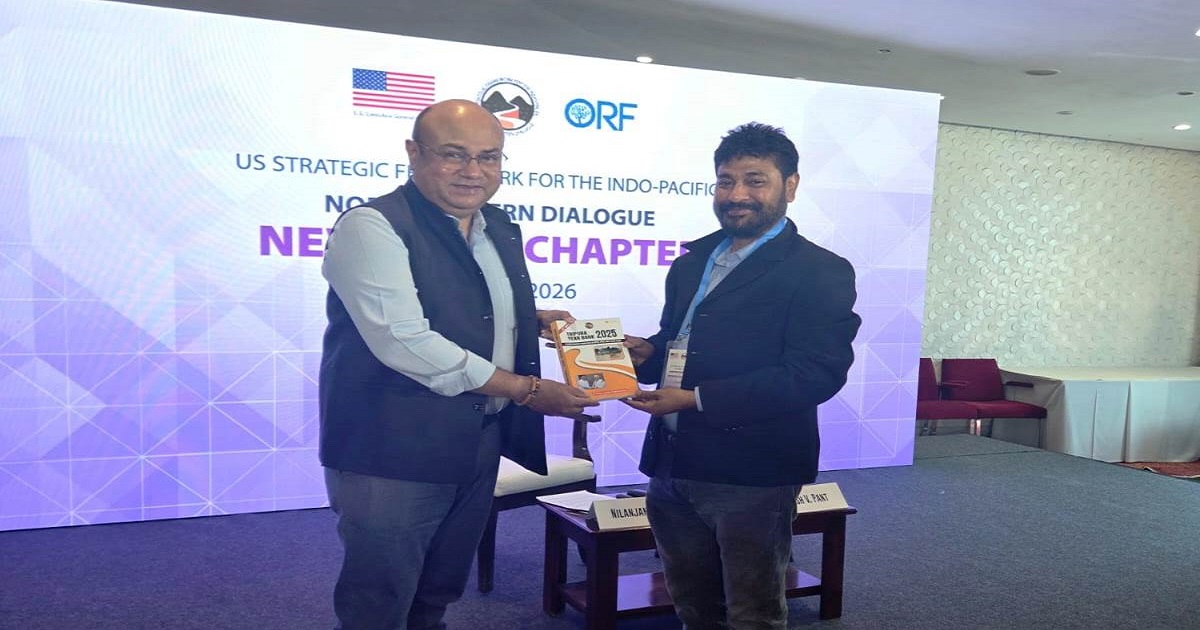
These issues were discussed in detail at an important international policy dialogue titled 'US Strategic Framework for the Indo-Pacific: Northeastern Dialogue', held on March 12, 2026, at The Park Hotel in New Delhi.
The event was organized by the Observer Research Foundation (ORF) and funded by the United States Consulate General in Kolkata. The dialogue brought together policymakers, researchers, economists, business representatives, journalists, and civil society members to discuss the economic future, trade opportunities, connectivity challenges and strategic significance of Northeast India.
Experts at the conference emphasized that Northeast India occupies a unique geographic position between South Asia and Southeast Asia. The region shares international borders with Bangladesh, Nepal, Bhutan, Myanmar and China, making it one of the most strategically located parts of India for cross-border trade and regional connectivity.
Participants highlighted that with improvements in infrastructure, port connectivity, road networks, and digital communication systems, the Northeast could rapidly evolve into a major hub for industry, tourism, and agriculture-based economic activity.
Speakers also noted that recent political developments in neighboring countries could positively influence the economic prospects of Northeast India. The establishment of democratic governments through recent elections in Bangladesh and Nepal, according to many experts, has created an atmosphere conducive to regional cooperation.
Political stability in these neighboring countries is expected to strengthen border trade, regional connectivity and economic collaboration. In particular, Bangladesh plays a crucial role in providing Northeast India with access to the sea.
Improved connectivity through Bangladesh would significantly reduce transportation distances between the Northeast and global markets. This would allow states such as Tripura, Assam, Meghalaya and Mizoram to expand exports and integrate more efficiently with international trade routes.
Maitri Setu: A Strategic Opportunity for Tripura
One of the most promising developments for Tripura is the imminent opening of the Maitri Setu bridge and the Sabroom Land Port.
During the February dialogue in Delhi, Jayanta Singh, Chairman of the Land Port Authority of India, informed participants that the long-awaited Sabroom ICP and Maitri Setu connecting Sabroom in Tripura with Ramgarh in Bangladesh is expected to become operational very soon.
Once the bridge becomes fully functional, the distance between Sabroom and major Bangladeshi port cities such as Chittagong and Cox’s Bazar will be significantly reduced. This will provide the landlocked Northeast with a much shorter route to the Bay of Bengal.
The Integrated Check Post (ICP) at Sabroom is also nearing completion. When operational, it will facilitate customs clearance, immigration procedures and cargo handling for international trade. This integrated infrastructure is expected to open new opportunities for imports, exports and cross-border commerce.
Experts believe that once Maitri Setu becomes operational, Tripura could emerge as one of the most important international trade gateways for Northeast India. The bridge is expected to dramatically enhance commercial connectivity between India, Bangladesh and the wider Southeast Asian region.
Infrastructure Development Transforming the Northeast
Connectivity infrastructure was another key focus of the Delhi dialogue. For many decades, the economic growth of the Northeast was constrained by difficult terrain, limited industrialization and inadequate transportation networks.
However, recent years have witnessed significant investments in roads, railways, inland waterways and digital connectivity across the region. The Government of India has also prioritized strengthening links between the Northeast and the Bay of Bengal through riverine and maritime infrastructure.
Improved connectivity is expected to reduce logistical costs, encourage private investment and boost regional trade.
Strategic Importance in the Indo-Pacific Region
Experts also highlighted the growing strategic importance of Northeast India in the broader Indo-Pacific geopolitical framework.
As India and the United States seek to promote a free, open and secure trade environment in the Indo-Pacific region, the Northeast is increasingly being seen as a critical area for economic cooperation and regional engagement.
The Northeastern Dialogue in Delhi brought together more than 230 participants from government agencies, academic institutions, business communities, media organizations and civil society.
Before the Delhi meeting, six regional dialogues were held across the Northeast, including in Meghalaya, Assam, Sikkim, Tripura and Mizoram, while a virtual discussion was organized in Manipur. A national-level consultation was also held in Kolkata before the final Delhi dialogue.
Participation from Tripura
Representatives from Tripura also took part in this important international policy discussion.
Among them were Anup Roy, representing the Tripura Chamber of Commerce, and Tushar Kanti Chakraborty, President of the Tripura Merchants Association.
Veteran journalist Jayanta Debnath, editor of tripurainfo.com, was also invited to participate in the dialogue.
During the discussions, representatives from Tripura highlighted the state’s stable administrative environment and emphasized that Tripura offers favorable conditions for industrial investment. They also pointed out the enormous potential in sectors such as rubber, agarwood, bamboo, tea, information technology and tourism.
The participants further emphasized that border trade with Bangladesh could play a transformative role in Tripura’s economic development.
From a Remote Frontier to an International Economic Zone
According to experts on Northeast India, if regional cooperation, cross-border trade and connectivity projects are implemented effectively, the region could soon emerge as one of India’s major economic growth centers.
The experts also says that the transformation of the Northeast has been shaped by long-term policy initiatives such as former Prime Minister PV Narasimha Rao’s 'Look East Policy' and the current government’s 'Act East Policy' under Prime Minister Narendra Modi. India's initial policy focusing on the North East region was rooted in the 'Look East Policy' (LEP), which was first launched in 1991–1992 by the government of Prime Minister PV Narasimha Rao. These policies aim to integrate Northeast India with Southeast Asian economies through improved infrastructure and trade partnerships.
As a result, what was once considered a distant frontier region is gradually evolving into a strategic economic corridor linking India with its eastern neighbors.
When the Maitri Setu at Sabroom becomes fully operational, Tripura could truly become India’s gateway to Southeast Asia, opening new horizons for trade, investment and regional cooperation.
(The author, Jayanta Debnath, is a senior journalist and editor of tripurainfo.com.)
(Tripurainfo)
more articles...