A Review of the third staging of the play Rangchak ni Khumpui in Muktodhara hall
Prasanta Chakraborty
April 21, 2026
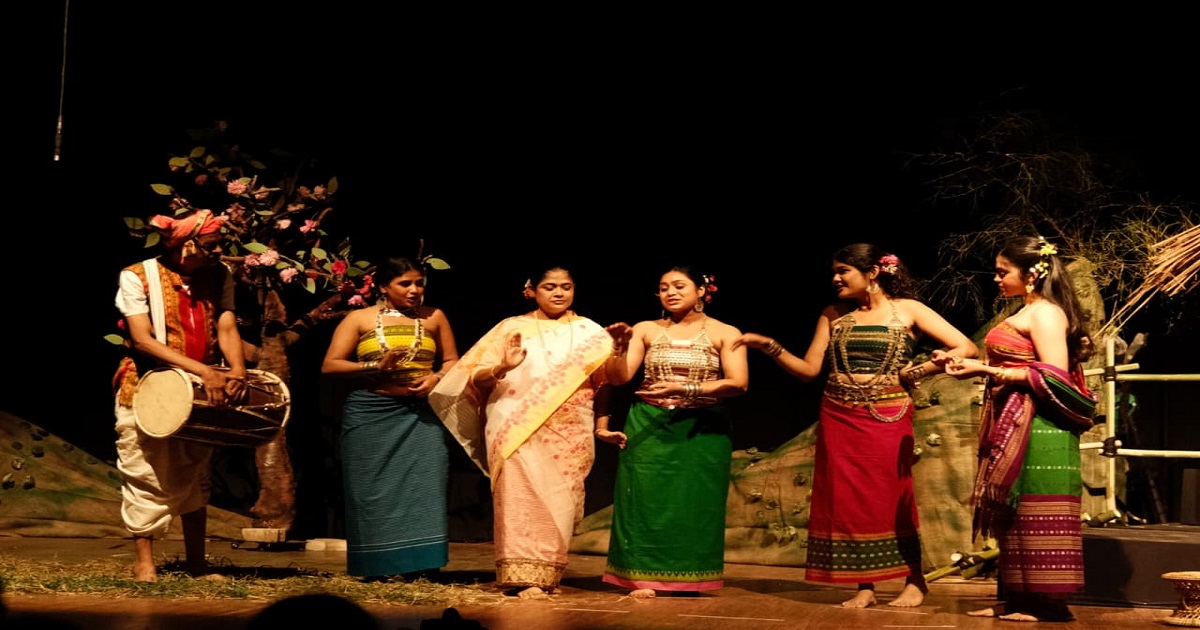
Natyabhumi Group Theatre staged their play
Rangchak ni Khumpui in an audience-packed Muktodhara. It was their third show
of the play, the first time was staged in Rabindra Shatabarshiki Bhawan. It was
based on an Indian classical play of Shudrak, Mṛcchakaṭika. Mṛcchakaṭika ("The
Little Clay Cart"), a 10-act Sanskrit drama by King Śūdraka (c. 2nd
century BC–5th century AD), follows the romantic tale of Charudatta, a
noble but impoverished merchant, and Vasantasena, a wealthy, virtuous courtesan
in ancient Ujjayini. Their love overcomes poverty, attempted murder, and
political conspiracy by the evil Shakara.
The play Rangchak ni Khumpui blends classical Sanskrit drama with
Tripuri folk culture. It is a fusion of traditional themes with local cultural
elements, thereby making a successful attempt to reimage classical stories.At the very outset, the director, Partha
Pratim Acharya, proclaims, like a chorus, the playwright's intention to
deconstruct the love story of the classical play and bring to the fore their
love for the country, which grew out of an individual’s love for the other. He
quotes from various distinguished personalities, even Derrida, to justify the
playwright’s intention to deconstruct. Quoting Derrida, Mr Acharya claims that
Derrida suggests deconstructing a text to overturn the hierarchy. Mr Acharya
further adds that, according to Romain Rolland, a play is the centre of
power for the theatre-goers. He further points out that the little clay cart of
Shudrak is Khumpui (a Ginger Lily flower)– in Rangchak ni Khumpui. This
exercise on the part of the director seems unnecessary. Nevertheless, the
director has taken care to use sound, background music, light, and even the
songs from backstage appropriately.Madhumita Nath, as a playwright and an actress,
is tremendously successful. So are the other characters. Nilashma Choudhury,
playing the role of Larima, deserves special appreciation. Apraditi as Khumtia,
Susmita Pal as Jayanti, Subhrajit Pal as Hamjakoma, Suman Majumder as Fankorok,
Surajit Das as Thailafru, and Trishan Dev as Nokha deserve the audience's
attention. The movement of Trishan while he was on his way to steal is superb.
The character of the villain and his presence, his attempt to make love to
Larima, and, in the climax, when, towards the end of the play, he killed Larima
and wounded the Buddhist monk, create agitation against the villain and a sense
of pity for the victim. The audience felt relieved when villainy was exposed,
and the villagers’ united force defeated the villain. The relevance of the play
in the troubled contemporary society is beyond any question. The last scene,
where the old man meets the spirit of Larima, marks a universal appeal of love
that is not conjured but everlasting- a love for the motherland that has been generated
from the love of two individuals.In their role as Thoisa and Subrai, Samarjit
Banik and Sarajit Deb deserve appreciation.
In her role as the Buddhist disciple, Hitoporna Saha seems a bit weak so
far, as her voice modulation is concerned. Bikram Roy Choudhury, as Gaon Buro,
has a small role to perform, but his long association with theatre attracted
the audience’s appreciation. Prabhat
Rudra Paul, in his role as Tokhirai, is also good.It appears that certain additions have been
made to the original thematic framework of the play since its first
performance—an evolution that, without doubt, strengthens and sharpens its
central thrust.The lighting and background music are deftly
orchestrated by Pradip Das and Soumendra Nandy, lending the production a
compelling atmospheric depth. Stage preparation and costumes are competently
managed by Subhrajit Paul and Pijush Kanti Roy, ensuring visual coherence
throughout. The costume design, helmed by Apradeeti, is both apt and
thoughtfully executed. Above all, Parthapratim Acharya merits sincere
appreciation for his meticulous direction, which binds every element of the
staging into a cohesive and impactful whole.
(Tripurainfo)
more articles...