Sachin Dev Burman : Born a Prince, Remembered as a Maestro
Prasanta Chakraborty
October 3, 2026
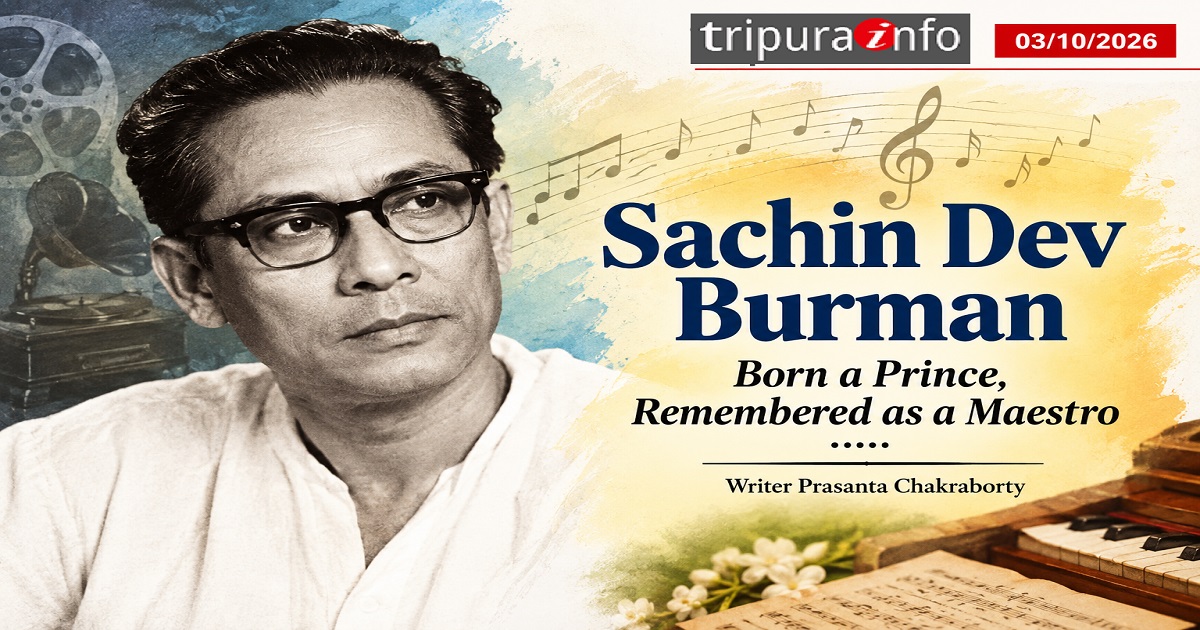
He was born a prince, but his greatest inheritance was music. Sachin Dev Burman carried the name of Tripura from its royal household to the wider world of Indian music. Rooted in the folk traditions of Bengal and the Northeast, his melodies crossed linguistic and geographical boundaries and eventually found a permanent place in the hearts of millions.
Sachin Dev Burman ( First October 1906–1975) was born into royalty on both sides of his family. His mother, Nirmala Devi, belonged to the royal family of Manipur, while his father, Nabadwipchandra Dev Burman, belonged to the royal family of Tripura. Because of this lineage, he was often addressed as Kumar Sachin Dev Burman, with Kumar meaning prince.
Yet there was a striking contrast between his aristocratic background and the character of his music. Born into privilege, he found his greatest inspiration in the lives and songs of ordinary people. The folk traditions of Bengal and the Northeast, the rhythms of river life and the simplicity of rural melodies became the foundation of his musical identity. He did not merely reproduce these traditions; he absorbed and transformed them, creating a style that was unmistakably his own.
A Changing Musical Landscape
Sachin Dev Burman's emergence coincided with a period of major change in Indian music. The post-Tagorean era, beginning roughly in the 1930s, witnessed remarkable experimentation in both vocal and instrumental music. Artists explored new combinations of music, dance and theatre, while pioneers such as Uday Shankar and Ravi Shankar introduced innovative interpretations of classical and mythological themes.
At the same time, musicians continued the rich traditions of thumri, khayal, dadra and ghazal while incorporating new influences. By the 1930s and 1940s, modern Bengali music had entered what would later be regarded as its golden era. Pankaj Kumar Mullick, Jaganmoy Mitra, Sudhirlal Chakraborty, Hemanta Mukhopadhyay and Salil Chowdhury were among the musicians who expanded its horizons through cinema, theatre, musical experimentation and social themes.
It was in this vibrant musical environment that Sachin Dev Burman had to establish himself. His royal background could give him social status, but it could not give him artistic recognition. He had to earn his place through talent, discipline and a deep understanding of music.
His greatest strength was his intimate knowledge of folk traditions. The songs of boatmen, fishermen and rural communities were not merely sounds he encountered; they formed part of the cultural world from which he drew his inspiration. He brought their natural rhythms and emotional simplicity into modern compositions and eventually into Indian cinema.
The Curious Tagore Connection
Sachin Dev Burman's artistic journey also presents an intriguing connection with Rabindranath Tagore. Like Tagore, he was born into an affluent family but developed a deep engagement with folk culture. Both demonstrated that privilege and artistic engagement with ordinary life were not necessarily contradictory.
Yet, unlike many musicians and artists of his generation, Sachin Dev Burman appears to have had little direct interaction with Tagore or the Tagorean musical tradition. This is particularly interesting because of Tagore's close association with the royal family of Tripura.
Tagore's relationship with the Tripura royal household began early in his life. He visited Tripura several times and maintained a close relationship with Maharaja Bir Chandra Manikya and his successors. The royal family also found a place in some of his literary works, notably Rajarshi, later adapted as Bisarjan, and Mukut.
Against this background, the apparent absence of a meaningful Tagore-Sachin Dev Burman relationship is intriguing. To understand this possibility, one has to look briefly at Sachin's family history.
A Royal Succession and Its Possible Shadow
Sachin's father, Nabadwipchandra Dev Burman (1854–1931), was the son of Ishanchandra Manikya, the ruler of Tripura who preceded his younger brother Bir Chandra Manikya. When Ishanchandra died in 1862, Nabadwipchandra was still a child and therefore could not immediately assume the throne. His uncle Bir Chandra subsequently became ruler.
The succession took place during a period of considerable political uncertainty. Across nineteenth-century India, princely states faced increasing pressure from the British, particularly over questions of succession. The British policy known as the Doctrine of Lapse had created widespread anxiety among ruling families. The decision to place the young Nabadwipchandra aside in favour of his adult uncle may therefore have been influenced, at least in part, by the need to protect the Tripura kingdom from political uncertainty.
Some historical interpretations suggest that Nabadwipchandra remained resentful about being denied the succession. According to Rajyeshwar Mitra's analysis, this resentment may have influenced his attitude towards Tagore, who had a close relationship with Bir Chandra Manikya and the Tripura royal household.
If this interpretation is accepted, it offers a possible explanation for the distance between Nabadwipchandra and Tagore and, perhaps, for Sachin Dev Burman's own lack of contact with the poet. However, this connection must be treated with caution. There is no conclusive evidence that Nabadwipchandra's alleged resentment directly influenced his son's relationship with Tagore. It remains an interesting historical possibility rather than an established fact.
From Folk Tradition to National Recognition
Whatever the reasons for his distance from Tagore, Sachin Dev Burman's musical journey followed its own distinctive path. While Tagore created an influential musical tradition of his own, Sachin drew deeply from folk sources and carried their simplicity and emotional power into modern Bengali and Hindi music.
His achievement lay not simply in using folk melodies but in understanding their essence. He could take the sounds of rural Bengal and transform them into music that was sophisticated without losing its natural quality. His compositions retained the flavour of the soil while speaking to listeners far beyond it.
This ability to combine tradition with modernity became one of the defining features of his career. He demonstrated that folk music could enter the mainstream without losing its character. His association with Indian cinema further widened his musical world, allowing his compositions to reach audiences across the country.
A Legacy Beyond Borders
Sachin Dev Burman's story is remarkable because of the contrast between his birth and his artistic journey. He was born into royalty, yet his music drew strength from the lives and songs of ordinary people. His background connected him to the history of Tripura, while his music connected him to generations of listeners across India.
He became a cultural bridge between tradition and modernity, between folk and popular music, and between the cultural landscape of Northeast India and the wider world of Indian music.
For Tripura, his achievement has a special significance. He carried the name of his homeland into the national cultural consciousness and gave its royal heritage a lasting artistic dimension. His music outlived the world of princely states and continues to speak to listeners who may know little of the circumstances of his birth but recognise the unmistakable beauty of his melodies.
His greatest legacy is therefore not his royal lineage, but the musical world he created. Decades after his death, Sachin Dev Burman's songs remain alive, carrying with them the fragrance of the soil, the rhythm of the rivers and the emotional depth of the folk traditions that shaped him.
Reference:-
Mitra, Rajyeshwar. Agartalaye Sachin Dev Burman, Desh, vol. 62, no.5, Dec 1994,
(Tripurainfo)
more articles...