World Hepatitis Day 2026: Grassroots Innovation and Strategic Imperatives
Prof. (Dr.) Pradip Bhaumik
Founder President and Hon. Director, Hepatitis Foundation of Tripura (HFT), India.
Email: [email protected]
July 24, 2026
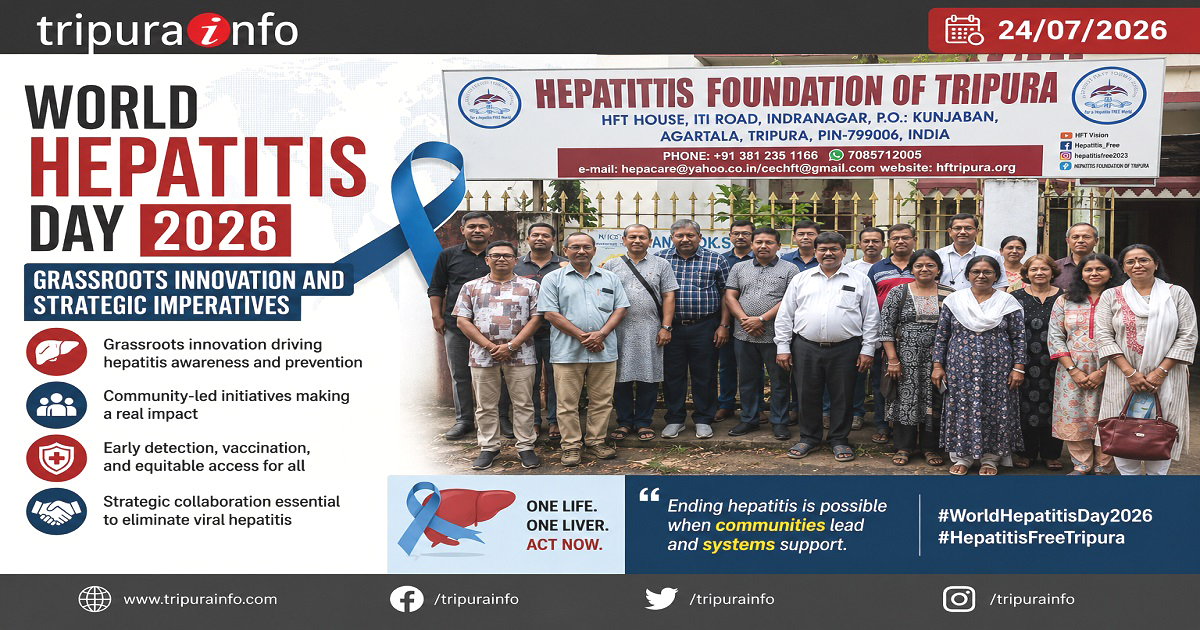
Prologue:
World
Hepatitis Day (WHD) 2026 arrives at a decisive juncture in global public
health. With only four years remaining to achieve the World Health
Organization’s (WHO) ambitious mandate to eliminate viral hepatitis as a major
public health threat by 2030, the global community faces both an urgent
imperative and an unprecedented opportunity.
At this junction Global Public Health Declaration on
World Hepatitis Day 2026 is
“Eliminating viral hepatitis is not
merely a clinical goal; it is a fundamental test of health equity, health
system resilience, and global public health commitment. As the world reaches
the critical four-year countdown to 2030, grassroots models prove that
resource-constrained regions can pioneer solutions capable of transforming
global outcomes.”
While
the broader etiology of liver diseases continues to evolve-marked by rising
global rates of Metabolic Dysfunction-Associated Steatotic Liver Disease (MASLD),
Alcohol-related liver disease (ALD), and drug-induced liver injury (DILI)-viral
hepatitis remains unique: it is the
most preventable, treatable, and, in the case of Hepatitis C, curable cause of
chronic liver disease worldwide.
Aligning
with the global WHO 2026 campaign, “Hepatitis:
Let’s Break It Down,” this comprehensive treatise examines the global
burden of liver disease and highlights the historic, community-led response of
the Hepatitis Foundation of Tripura
(HFT). Established on 28 July 2002-nearly a decade before the formal
designation of WORLD HEPATITIS DAY by
WHO in 2011 and sixteen years prior to India's National Viral Hepatitis Control
Program (NVHCP) in 2018-HFT has served as an international model of grassroots
public health intervention. Through relentless community devotion, HFT has
successfully vaccinated over 37% of the
entire population of the state of Tripura, pioneered mass vaccination
drives since 2002, and successfully institutionalized birth-dose Hepatitis B
vaccination into public policy.
As
HFT mobilizes more than 150 state-wide
programs over 15 days culminating in the flagship State-Level WHD 2026
Observation on July 28, which will be addressed by Chief Minister of Tripura,
Prof ( Dr.) Manik Saha, as chief guest this document provides policy makers,
international public health experts, and clinical leaders with a blueprint for
action. HFT’s actionable operational model-“Know it, test it, Treat it, vaccinate it, eliminate it”-offers a
scalable framework to bridge diagnostic gaps, overcome systemic barriers, and
achieve complete elimination by 2030.
The Changing Global Paradigm of Liver Disease:
The
landscape of liver diseases has undergone a profound transformation over the
past three decades. Historically viewed primarily through the lens of
infectious diseases and high-volume alcohol consumption, liver pathology is now
recognized as a complex, multi-factorial spectrum reflecting shifts in global
demographics, dietary patterns, metabolic health, and pharmacological
exposures.
Metabolic Dysfunction-Associated Steatotic Liver
Disease (MASLD):
Formerly
designated as Non-Alcoholic Fatty Liver Disease (NAFLD), MASLD has emerged as
the most rapidly growing cause of chronic liver disease globally. Driven by the
worldwide epidemic of obesity, type 2 diabetes mellitus, dyslipidemia, and
metabolic syndrome, MASLD now affects an estimated 30% to 32% of the global
adult population.
Alcohol-Related Liver Disease (ALD):
Alcohol
misuse continues to exert a heavy toll on global liver morbidity and mortality.
Changing consumption patterns, particularly among younger demographics and in
developing economies, reinforce the need for integrated addiction medicine and
hepatology care.
Autoimmune and Genetic Metabolic Liver Diseases
Autoimmune
Hepatitis (AIH), Primary Biliary Cholangitis (PBC), and Primary Sclerosing
Cholangitis (PSC) represent immunologically mediated, chronic progressive
conditions that present unique diagnostic and therapeutic challenges.
Drug-Induced Liver Injury (DILI) and Toxin Exposure
With
expanding pharmacotherapy, over-the-counter supplement availability, and
environmental exposure to hepatotoxins (such as aflatoxins in contaminated food
supplies), DILI has become a major cause of acute liver failure globally.
Why Viral Hepatitis Demands Urgent Priority
-
Unmatched
Preventive Capability:
Highly effective recombinant vaccines provide lifetime protection against
Hepatitis B. When administered within 24 hours of birth as a universal birth dose, transmission from mother to child is virtually eliminated.
-
Direct
Antiviral Cures:
Direct-acting antiviral (DAA) regimens can cure over 95% of chronic Hepatitis C
infections within an 8 to 12 week oral course, with minimal side effects.
-
Effective
Long-Term Suppression
provide potent viral suppression for chronic Hepatitis B, halting disease
progression to cirrhosis and dramatically reducing liver cancer risk.
-
Defined
Transmission Pathways:
Infection occurs through blood exposure, unscreened transfusions, unsterilized
medical/dental equipment, unsafe injections, and perinatal transmission.
Despite
these safe and effective tools, viral
hepatitis continues to claim over 1.3 million lives annually, placing it
alongside tuberculosis as a leading infectious killer worldwide. This paradox-having
the medical tools to eliminate a killer disease while millions remain
untreated-makes viral hepatitis one of the most pressing public health
challenges of our time.
The WHO Global
Strategy and Elimination by 2030:
In
2016, the World Health Assembly endorsed the landmark Global Health Sector
Strategy on Viral Hepatitis, setting a goal to eliminate viral hepatitis as a
major public health threat by 2030. To realize this target, the global
framework establishes rigorous, quantified benchmarks against a 2015 baseline:
- 90% Reduction in New Infections,
- 65% Reduction in Mortality.
- 90% Vaccination Coverage: Achieving universal coverage of the three-dose
Hepatitis B vaccine, including universal birth-dose administration.
- 100% Blood Safety and Injection Safety.
- 80% Diagnosed and Treated.
Count down: The Urgency of World Hepatitis Day 2026
World
Hepatitis Day 2026 marks the arrival of the four-year countdown to the 2030 deadline. The global progress
report presents a mixed picture:
While
infant Hepatitis B immunization rates have increased globally, significant gaps
remain in diagnostic coverage and adult treatment access. Globally, less than
15% of people living with chronic Hepatitis B and less than 25% of those with
Hepatitis C are aware of their status.
WHD
2026 is therefore not merely an annual observance; it is a critical checkpoint
for national health ministries, donor organizations, and civil society.
2026 WHO Theme: "Hepatitis: Let's Break It
Down"
The
theme for World Hepatitis Day 2026, “Hepatitis:
Let’s Break It Down,” serves as an urgent call to dismantle systemic
barriers to care:Break
Down Diagnostic Barriers:
Replace complex, centralized laboratory algorithms with point-of-care rapid
diagnostic testing (RDT) and decentralized dried blood spot (DBS) testing
integrated into primary care.Break
Down Financial Hurdles:
Reduce out-of-pocket costs for diagnosis and treatment.
-
Break
Down Stigma and Misconceptions.
-
Break
down Systemic obstacles: Convergence of Hepatitis B , Hepatitis c and HIV care at every level.
-
Pioneering Grassroots Public Health: The Journey of
Hepatitis Foundation of Tripura (HFT)
-
While
global frameworks provide guidance, successful implementation depends on local
action. In northeastern India, the Hepatitis
Foundation of Tripura (HFT) offers a compelling example of community-led
public health impact.
Long
before global health institutions established formal elimination strategies,
HFT began addressing viral hepatitis in 2002.
- Pre-dating WHO World Hepatitis Day (2011): HFT was actively organizing
state-wide programs nine years before WHO formally recognized July 28 as
World Hepatitis Day. In fact 28 July, the birth day of Hepatitis B discoverer
scientist Baruch Bloomberg, is also the foundation day of HFT.
- Pre-dating National Policy (2018): HFT demonstrated the viability of community
Hepatology long before India launched its National Viral Hepatitis Control
Program (NVHCP) in 2018.
Driven
by dedicated medical professionals, social advocates, and volunteers, HFT
proved that public health progress does not have to wait for top-down
international directives.
Key Historical Achievements and Methodologies Mass
Immunization Campaigns (Since 2002)
With
active support of Govt of Tripura and local community contributions, HFT
launched systematic mass vaccination drives for Hepatitis B across urban,
rural, and remote tribal districts of Tripura since 2002.
Supported
by the Bristol Myers Squibb Foundation (BMSF) in 2009 HFT launched historic mass
Hepatitis Vaccination / Eradication
program in a style of pulse polio
vaccination, and reached remote communities across the state's hills and
valleys.
Pioneering Universal Birth-Dose Immunization (2011)
Recognizing
that perinatal transmission is the primary route for chronic Hepatitis B
infection, HFT organized free Hepatitis B birth-dose vaccination programs in
major healthcare facilities in 2011. Recognizing its public health value, the
Government of India and State Health Department institutionalized free
birth-dose immunization across state healthcare facilities in 2012.
Power of Community Devotion
In
an era before advanced artificial intelligence, machine learning analytics,
digital tracking apps, or social media campaigns, HFT achieved its public
health impact through grassroots organization and community engagement:
- Door-to-Door Awareness: Volunteers, local teachers, youth groups, and
health workers mobilized neighborhoods village by village.
- Culturally Tailored Outreach: Public messaging was translated into local
languages, including Kokborok and Bengali, using street plays, folk songs,
and community gatherings.
- Trust and Engagement: By partnering with trusted local institutions,
schools, and civic associations, HFT demystified viral hepatitis and
overcome vaccine hesitancy.
Impact Benchmark: Vaccinating 37% of a State's
Population
Through
these sustained efforts, HFT achieved an extraordinary milestone: directly vaccinating over 37% of the entire
population of Tripura against Hepatitis
B.
This
accomplishment represents one of the largest self-driven, non-governmental
public health vaccination campaigns in modern medical history. By establishing
high community protection against Hepatitis B, HFT created a measurable decline
in HBV transmission, significantly reducing the future burden of liver
cirrhosis and liver cancer due to Hepatitis B across generations in the region.
Five pillar action frame work of HFT: WHD 2026
Observance in Tripura
To
translate global strategy into local execution, HFT formulated an actionable
five-pillar operational theme for WHD 2026:
Operational Framework=Know It⟶Test It⟶Treat It⟶Vaccinate It⟶Eliminate It.
1. KNOW
IT:
Elevate public health literacy across every sector of society..
2. TEST
IT:
Expand access to free, rapid screening tests (HBsAg and Anti-HCV and HIV )
across primary health centers, community centers.
3. TREAT
IT:
Ensure immediate linkage to care for all individuals testing positive, through
state health partnerships.
4. VACCINATE
IT:
Reinforce universal birth-dose coverage for newborns within 24 hours and
maintain catch-up vaccination drives for adolescents, healthcare personnel, and
high-risk adult groups.
5. ELIMINATE
IT:
Establish continuous epidemiological surveillance, maintain public health
momentum, and secure long-term political and financial commitments for complete
regional elimination.
The 15-Day Campaign Blitz: 150+ Programs Across
Tripura
In
the two weeks leading up to World Hepatitis Day on July 28, 2026, HFT launched
an intensive statewide campaign:
- Over 150 Outreaches Organized: Conducted across all 8 districts of Tripura,
reaching urban centers like Agartala as well as rural and tribal hamlets.
- Multi-Sectoral Engagement:
- Educational
Institutions, Workplaces and Public Transport, Health Clinics. Grassroots
Dialogues, encourage voluntary testing.
Grand State-Level Program (July 28, 2026)
This
fortnight of action culminates on July
28, 2026, in a state-level observance in Agartala, bringing together
political leaders, public health administrators, clinical experts, and
community members.
The
presence of top leadership underscores the alignment between political
commitment and grassroots advocacy:
- Hon’ble Chief Minister of Tripura Prof ( Dr.) Manik Saha will be present as Chief Guest. The Chief
Minister's leadership highlights the state's commitment to prioritizing
viral hepatitis elimination within its broader health agenda.
- Hon’ble Heath secretary Of State Shri Kiran Gitte, IAS Bringing administrative support to
streamline health infrastructure, resource allocation, and
cross-departmental coordination.
- Shri Saju Vaheed, IAS, Mission Director, National Health Mission -
NHM): Facilitating
the integration of screening, diagnostics, and treatment supplies into
primary healthcare facilities statewide.
- Dr. Debashree Debbarma , Director of Health Services: Ensuring clinical standards,
diagnostic quality, and medical training across state hospitals and
wellness centers.
This
event celebrates almost 25 years of
community action while launching the final four-year strategic roadmap toward
complete viral hepatitis elimination in Tripura by 2030.
Key Priorities
for the 2026–2030 Final Push
As
the global health community evaluates strategies for the remaining four years
to 2030, the operational experiences of HFT and global public health evidence
highlight four priority areas:
1. Full Integration into
Primary Health Care (PHC) and Universal Health Coverage (UHC).
2. Targeted
Micro-Elimination Strategies
3. Securing Supply Chains
and Universal Birth-Dose Access.
4. Addressing
Misinformation and Rebuilding Public Trust
The Tripura Model as an International Benchmark for
LMICs
The
achievements of the Hepatitis Foundation of Tripura offer valuable lessons for
Low- and Middle-Income Countries (LMICs) and resource-constrained health
systems worldwide:
Strategic
Lessons from the Tripura Model
-
Grassroots
Civil Society Can Lead Change: High-impact public health initiatives do not always
require initial government mandates; organized civil society can demonstrate
feasibility, generate public demand, and inform state policy.
-
Community
Devotion Drives Scale:
Dedicated volunteers, local health advocates, and civic engagement can achieve
high coverage rates even in the absence of advanced digital infrastructure or
high per-capita spending.
-
Addressing
the Full Continuum of Care: Public health messaging must link screening directly to
care, treatment, and prevention: "Know it, Test it, Treat it, Vaccinate
it, Eliminate it."
-
Sustaining
Public Commitments:
Achieving long-term targets like the 2030 WHO goals require continuous advocacy
to keep viral hepatitis elimination at the forefront of the public health
agenda.
Conclusion and Global Call to Action
World
Hepatitis Day 2026 serves as a clear reminder that the target of eliminating
viral hepatitis by 2030 is achievable. The necessary tools-effective vaccines,
accurate rapid diagnostics, and curative or suppressive antiviral treatments-already
exist. What is required now is the collective determination to remove the
barriers preventing individuals from accessing these life-saving services.
The
experience of Tripura, India, demonstrates what can be accomplished when
clinical leadership, grassroots dedication, and political support unite behind
a common goal. Having vaccinated over 37% of its population through
community-led initiatives, Tripura shows that resource limitations do not have
to be a barrier to public health progress.
As
global leaders, policy makers, health workers, and advocates observe World
Hepatitis Day 2026 under the theme “Hepatitis:
Let’s Break It Down,” the message is clear: Break down the barriers, expand testing and treatment, protect future
generations through vaccination, and make viral hepatitis elimination a reality
by 2030.
(Tripurainfo)
more articles...