Did the BJP Form the Government in Tripura Because of Biplab Kumar Deb?
Ranajay Deb ( Former BJP State President, Tripura)
August 30, 2026
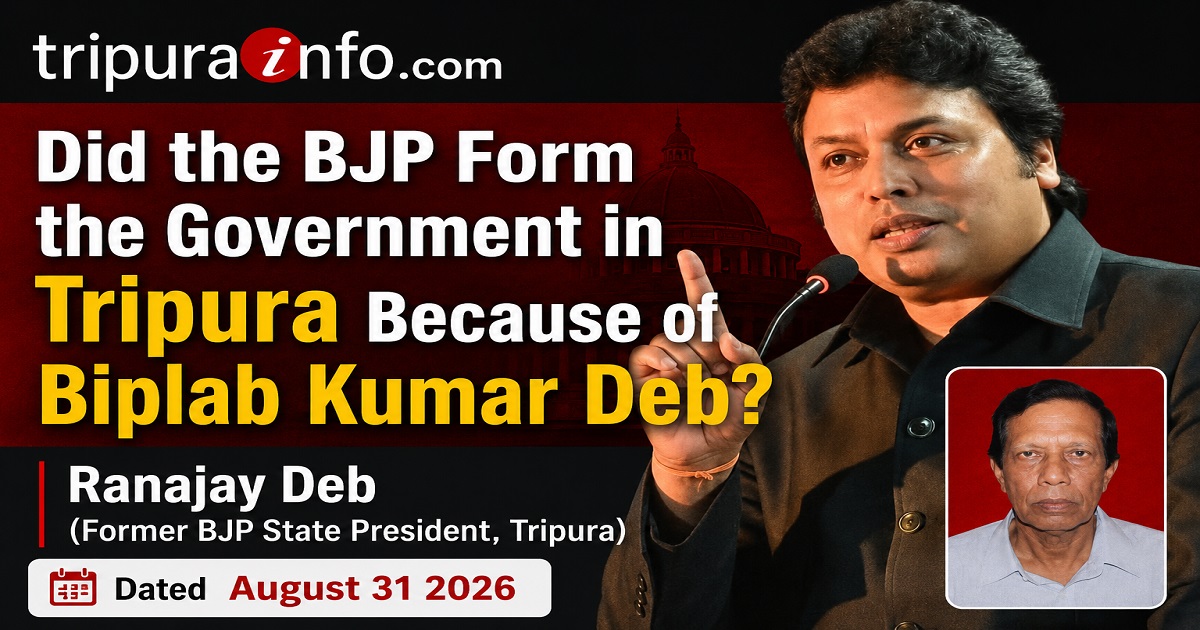
Recently, BJP national president Shri Nitin Nabin appointed former Tripura BJP state president, former Chief Minister, former Rajya Sabha MP and current Tripura West Lok Sabha MP Shri Biplab Kumar Deb as a General Secretary of the party’s Central Committee.
I sincerely thank Shri Nitin Nabin for giving a person from Tripura a position in the BJP’s central leadership. I also extend my heartfelt congratulations to Shri Biplab Kumar Deb. I firmly believe that he will discharge his new responsibility with dedication and efficiency.
Biplab Kumar Deb was born in Udaipur, Tripura, on November 25, 1971. He is a son of the soil, and spent a significant part of his education in Udaipur. After completing his college education, he moved to Delhi. I do not have detailed information about his early days there or how he established himself initially.
However, according to the information available to me, he subsequently came into contact with Shri Govind Acharya, then a BJP national general secretary (organisation). I understand that Shri Acharya appointed Biplab Deb as his personal secretary. I may be mistaken about some aspects of this information, and I am open to correction.
After the NDA government came to power, when Atal Bihari Vajpayee was Prime Minister and Smt. Rita Verma was a Union Minister, Biplab Kumar Deb, as far as I know, served as Resident Secretary at her residence.
At that time, I was the BJP state president of Tripura. I was introduced to Biplab Deb through Shri Tamal. Whenever I visited Delhi, Biplab Deb treated me well.
Gradually, Biplab Deb became well known in various circles of the BJP and the RSS. At one point, he was introduced to Shri Krishna Gopal, a senior all-India RSS leader. I came to know that Krishna Gopalji had affection for Biplab Deb.
In my view, this was the first major turning point in Biplab Deb’s political career.
THE INITIATIVE TO BRING BIPLAB DEB TO TRIPURA
After this, several leaders began seriously thinking about the BJP’s future in Tripura. Tinku Roy, Ranjan Dey,
Biswa Kalyan Nath, Pratima Bhowmik, Swapan Adhikari and a few others felt that the party had not made the expected progress under the state presidents who served after my tenure.
They believed that if the BJP was to have a realistic opportunity to form a government in Tripura, it would require closer coordination with the central leadership of the BJP and the Sangh Parivar.
This was when a Delhi-centred initiative began. Tinku Roy maintained regular contact with me. I was also in contact with Ranjan Dey and Swapan Adhikari.
The central leadership in Delhi was gradually convinced that there was a genuine possibility of political change in Tripura. The next question was: Who could be projected to lead this campaign?
Biplab Deb’s name emerged.
Initially, I was told that Biplab Deb and his wife were not willing to accept the proposal. Eventually, however, they agreed.
At one meeting, Shri Krishna Gopalji reportedly told Biplab Deb that he should be taken to Tripura. From that moment, I believe, a major turning point began in Biplab Deb’s political career.
Later, Biplab Deb appeared alongside Amit Shahji at a public meeting at Astabal Maidan in Agartala. Amitji also addressed Biplab Deb from the stage, giving a clear indication that he was being brought to Tripura to take up an important responsibility.
A few days later, Biplab Deb was sent to Tripura as Prachar Pramukh and subsequently appointed state BJP president.
Once he assumed responsibility, Biplab Deb worked extremely hard. He worked for 16 to 17 hours a day, travelled extensively across the state and established contact with party workers. Sunil Deodhar and Ram Madhav also played active roles alongside him.
The rest is history.
In the 2018 Assembly election, the BJP won 36 seats and its alliance partner IPFT won nine, giving the alliance a total of 45 seats in the 60-member Assembly and enabling it to form the government.
But this raises the central question of my article:
Did the BJP form the government in Tripura solely because of Biplab Kumar Deb?
My answer is: No.
WHAT HAPPENED DURING THE STATE PRESIDENT ELECTION?
When Biplab Deb arrived in Tripura from Delhi, a large section of the state BJP organisation did not initially stand behind him.
Apart from Tinku Roy and some of those involved in bringing him from Delhi, I also supported him. From my experience, then-general secretary Shri Sundar Pal and then-secretary Rajib Bhattacharjee were also not fully aligned with him during the initial phase.
The situation subsequently changed.
When the election for state president took place, Biplab Deb faced Ram Prasad Pal. Ram Prasad Pal received 26 votes while Biplab Deb received 18.
In other words, Biplab Deb lost by eight votes.
Outside the venue, supporters of Ram Prasad Pal celebrated. For the central leadership, this was an uncomfortable situation because their preferred candidate had lost the election.
Subsequently, telephone communications took place between Delhi and Agartala. Eventually, Ram Prasad Pal was persuaded to accept the situation and Biplab Deb was declared state president.
Ram Prasad Pal and his supporters had to make considerable sacrifices and efforts to accept that decision and continue working for the party.
After Biplab Deb became state president in 2016, the entire organisation rapidly shifted its focus towards the 2018 Assembly election.
There was disagreement over the formation of the state committee because Rajib Bhattacharjee’s name was initially absent. Eventually, Rajib Bhattacharjee was made general secretary and the committee was announced.
Thereafter, Biplab Deb and Rajib Bhattacharjee worked together closely in the organisation.
Biplab Deb significantly accelerated the pace of organisational activity. He travelled extensively across the state and established contact with booth-level, mandal-level and local workers.
There was only one objective: the Left Front government had to be defeated in 2018 and the BJP had to form the government.
At the same time, Sunil Deodhar became deeply involved in organisational work in Tripura. Ram Madhav, central leaders and several Union ministers repeatedly visited the state.
I also devoted myself full-time to organisational work, travelling in my own vehicle.
Every day, large numbers of people from the Congress began joining the BJP. Some people from the CPI(M) also joined the BJP later.
Therefore, the 2018 victory was the combined outcome of years of organisational preparation, central support, the hard work of leaders and workers at different levels, and the prevailing political circumstances.
THE HISTORY OF TRIPURA BJP CANNOT BE FORGOTTEN
Biplab Deb has repeatedly been associated with the claim that before his arrival in Tripura, the BJP had secured only around 1.5 per cent of the vote.
I believe it is incorrect to judge the entire history of the Tripura BJP solely through the 2013 election results without understanding the party’s political journey since the 1980s.
I would request Biplab Deb to examine the Election Commission of India’s historical election data and see how many candidates the BJP fielded at different times and what percentage of votes the party received.
The old Lok Sabha and Assembly election results are particularly important, including the results from several constituencies in North Tripura.
According to the information available to me, in the 1999 Lok Sabha election, BJP candidate Jishnu Devvarma received around 1.54 lakh votes from the East Tripura constituency.
In 2004, when the BJP-led government at the Centre had lost power, the BJP fielded the late Pulin Dewan, who received around 1.04 lakh votes.
In both elections, the Congress finished third.
In 1998, the BJP also captured a Gram Panchayat in Tripura for the first time—Laxminagar, the village next to mine.
When the BJP formed the government in Tripura in 2018, the party already controlled 16 Gram Panchayats in North Tripura.
Therefore, portraying the BJP’s 2018 rise as having begun only from the 1.5 per cent vote share of 2013 gives an incomplete picture of the party’s history in Tripura.
THE ORGANISATION WAS ALREADY IN PLACE BEFORE
2018
Before Biplab Deb came to Tripura, BJP organisational committees already existed in almost every mandal across the state.
Except for certain areas of the TTAADC, local committees existed in most places, and booth committees were also functioning in several areas.
The Page Pramukh system was only beginning to be introduced across India at that time. It was subsequently organised in Tripura before the 2018 election.
Special committees were also formed at different levels for the election. The system of appointing polling agents at booths already existed.
Then a large number of Congress leaders and workers began joining the BJP.
Many of them believed that the Congress had no political future in Tripura. At one stage, several legislators who had moved from Congress to the Trinamool Congress also joined the BJP.
Towards the final phase before the election, Ratan Lal Nath joined the BJP from Congress. Some people also came from the CPI(M).
This created a broader political movement in the state: if the Left Front had to be removed, the BJP was seen as the only viable alternative.
That sentiment played an important role in the BJP’s 2018 victory.
At the same time, I felt that a distance was developing between Biplab Deb and some of the old BJP workers. Greater importance began to be given to newcomers, creating resentment among some longtime party workers who felt that their contribution was not being adequately recognised.
Subal Bhowmik’s political journey was also significant during this period. He left the Congress and formed the Gramin Congress before subsequently joining the BJP. His political journey included Congress, Trinamool Congress, Gramin Congress, BJP, another phase with Trinamool Congress and eventually a return to the BJP.
He had political ambitions, but ultimately did not achieve the position he had hoped for.
Therefore, giving Biplab Deb or Sunil Deodhar the sole credit for the BJP’s 2018 victory would be an oversimplification of history.
CANDIDATE SELECTION AND MY DECISION TO LEAVE ELECTORAL POLITICS
Towards the end of 2017, preparations for the Assembly election intensified.
Union ministers and central leaders began visiting Tripura frequently. Leaders, including the Chief Minister and others from Assam, also started coming to campaign in the state.
The entire state became politically active with the arrival of leaders and workers from different levels.
Then candidate selection began.
The instruction from Delhi was that candidates above 70 years of age would not be given tickets.
I had contested elections five times before—once in 1988 on my own initiative and four subsequent times after the party insisted that I contest.
In 2018, I was 73 years and seven months old. Therefore, I accepted the central leadership’s age policy.
However, I allege that Biplab Deb and Sunil Deodhar betrayed me in this process.
Several of my contemporaries were also relevant to the discussion, including my friends Ratan Chakraborty and Arun Chandra Bhowmik, as well as the late Arun Kanti Bhowmik, who was two years older than me.
I know that some of them personally tried to have me considered as a candidate.
I was not demanding a ticket for myself. My concern was that the interests and representation of old party workers were not being given sufficient importance.
Eventually, another candidate was selected from my Bagbassa constituency, and the BJP lost the seat.
Nobody can prove that I opposed the party’s decision.
Instead, I decided to withdraw from active politics and informed the then state president, Biplab Deb, in writing. He did not respond.
I later held a press conference and informed the people of Tripura about my decision.
The candidate selected from the constituency had come from the Congress, and I believed that his chances of winning were limited. However, because of the strong political wave in favour of the BJP at that time, he received a substantial vote.
Around three months later, after Biplab Deb had become Chief Minister, he called me and asked me to come to Agartala.
I went at his request.
He told me, “Dada, I have not accepted your resignation.”
In the presence of Ratan Lal Nath, Tinku Roy and Pratima Bhowmik, I was requested to accept the responsibility of a chairman.
I declined and later wrote to them making it clear that I would not accept the position.
I believe that I had quietly played a role in the process of bringing Biplab Deb to Tripura. I had also advised Tinku Roy at different stages about how the initiative should proceed.
Political circumstances subsequently changed.
Biplab Deb was removed as Chief Minister. Sunil Deodhar effectively moved out of Tripura politics, while Ram Madhav also moved away from his organisational responsibilities in the BJP and became associated with RSS work. He has since returned to the BJP’s central organisational structure.
BIPLAB DEB AS CHIEF MINISTER AND A MISSED OPPORTUNITY
In my view, when the BJP formed the government in 2018, Biplab Deb was not initially the central leadership’s first choice for Chief Minister.
I believe there was a possibility that Jishnu Devvarma could have been made Chief Minister. Had that happened, Tripura’s political equation might have developed differently.
After Biplab Deb became Chief Minister, his tenure witnessed political confrontation, allegations of attacks on opposition programmes, destruction of meeting platforms and controversies surrounding what were described as “bike brigades” and “helmet brigades.”
I do not believe such a political culture was positive for Tripura’s democratic environment.
In my view, a combination of Jishnu Devvarma as Chief Minister and Ram Prasad Pal as state BJP president could have created a strong organisational balance.
Both, in my assessment, placed greater importance on old party workers.
But that opportunity was lost.
SO, WHAT WERE THE REAL REASONS BEHIND THE BJP’S 2018 VICTORY?
From my perspective, the BJP’s historic victory in 2018 was the result of several factors working together.
First, the BJP had a single-party majority government at the Centre. This allowed Tripura’s organisation to receive substantial political, organisational and financial support from the central leadership.
Second, Tinku Roy and other leaders successfully convinced the central leadership that the BJP had a realistic chance of forming a government in Tripura.
Third, Prime Minister Narendra Modi, Amit Shah and several Union ministers and senior leaders repeatedly visited Tripura, strengthening the election campaign and organisational machinery.
Fourth, longtime BJP workers were joined by large numbers of newly arrived leaders and workers from the Congress and other political parties.
Fifth, Biplab Deb and Sunil Deodhar worked extremely hard. Their contribution and hard work cannot be denied.
Sixth, after decades of Left Front rule, growing public dissatisfaction and a desire for political change created a favourable environment for the BJP.
Therefore, the 2018 victory was not the achievement of one individual. It was the result of organisational groundwork, central support, years of preparation, political circumstances and the collective efforts of thousands of party workers.
WHAT MUST THE BJP DO TO RETURN TO POWER IN TRIPURA IN 2028?
If the BJP wants to return to power in Tripura with strength in the 2028 Assembly election, I believe it must immediately focus on several issues.
Take Strong Action Against Corruption and Mafia Rule
Anyone involved in corruption or mafia activities must face strict action, irrespective of how powerful or senior that person may be. If necessary, such individuals should be expelled from the party.
Restore the Dignity of Old Party Workers
Old workers must not be remembered only during elections. Their sacrifices, experience and years of organisational contribution must be genuinely recognised and respected.
Run the Government Democratically
Opposition voices should not be treated as enemies. They are an essential part of a democratic system. Transparency and accountability in administration must be strengthened.
Allow the Police to Function Independently
The police should not be used as an instrument of the ruling party. The people must regain confidence that the law applies equally to everyone.
Stop Unrealistic or False Promises
Regarding promises that have not been fulfilled—such as a railway division at Dharmanagar and the return of money deposited with Rose Valley—the government must give people a clear explanation.
Focus on Actual Development Rather Than Slogans
Instead of political slogans such as “One Tripura, Best Tripura in three years,” the government should demonstrate measurable and tangible development.
Strengthen the BJP’s Own Organisation Among Tribal Communities
The BJP should not depend solely on its political equation with the Tipra Motha. It must strengthen its own organisation and leadership among tribal communities. Organisational support from the Sangh Parivar can also be utilised for this purpose.
FINAL WORDS
I have written at length.
My intention is not to personally attack anyone. As someone who has been directly involved in the long political journey of the Tripura BJP, I have placed before readers what I have seen, experienced and understood from my own political experience.
I do not deny Biplab Deb’s hard work, the amount of time he devoted to the organisation or his efforts before the 2018 election.
However, if the formation of the BJP government in Tripura is credited solely to one individual, it would overlook the sacrifices of numerous old party workers, leaders, organisers and people who contributed to the party’s political struggle over many years.
History should not be reduced to an individual-centric narrative. The 2018 victory was built on years of organisational work, the sacrifices of old workers, the arrival of new workers, support from the central leadership, the weakening of rival political forces and the people of Tripura’s desire for change.
Through this article, I have presented one perspective based on my political experience and observations. Readers can judge the facts and arguments for themselves.
(Author- Ranajay Deb is Former BJP State President, Tripura)
Disclaimer: This article is based on Shri Ranajay Deb's own statements, experiences, observations and political opinions, and is being reproduced as originally published on his Facebook page written by him. TripuraInfo.com does not independently verify or endorse the claims made in this article. The views and opinions expressed herein are solely those of the author, Shri Ranajay Deb, former BJP State President of Tripura.
(Tripurainfo)
more articles...