Upcoming Reforms Warranted in the Indian Public Examination System
Sanjoy Roy
July 30, 2026
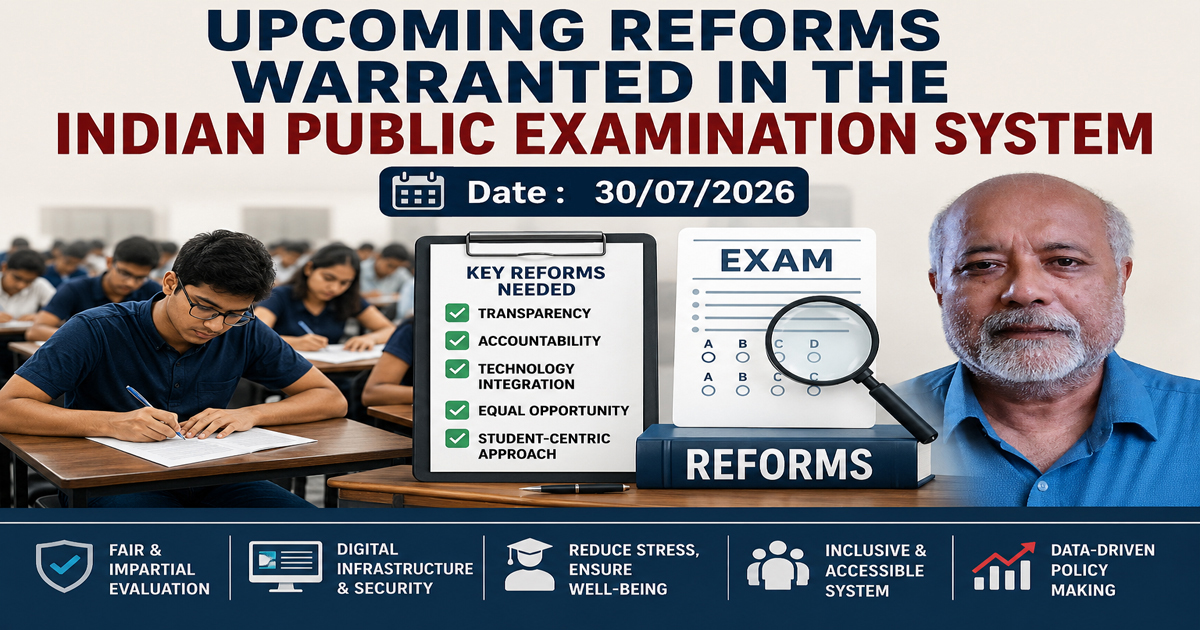
The Indian education and public
examination ecosystem stands at a critical historical juncture.
A series of deep-seated structural vulnerabilities, amplified by recent massive
youth protests at Jantar Mantar against
the existing ruling dispensation, has triggered an intense national
debate on how the country trains, tests, and evaluates its younger generation. The crisis reached a boiling point
following widespread public anger over repeated question paper leaks in
high-stakes examinations like the National Eligibility cum Entrance Test
(NEET-UG). Following a 37-day agitation demanding accountability, the fallout
led to the resignation of Union Education Minister Dharmendra Pradhan—who
accepted moral responsibility for the systemic failures—and his replacement by
Pralhad Joshi, alongside the removal and termination of top testing agency
officials and bureaucrats.
However, as citizens and experts
quickly pointed out, changing faces in ministerial berths or shuffling
bureaucratic portfolios amounts to nothing more than a superficial, temporary
political bandage. It is a classic administrative maneuver reminiscent of
"rounding up the usual suspects". The decay runs far deeper in the
system than individual incompetence or administrative oversights; it is
embedded in the very philosophy of mass standardized testing, extreme
centralization, and the hyper-commercialization of educational opportunities.
Every cancelled or compromised examination reinforces the shocking public
narrative that success depends not on hard work, but on the exploitation of
institutional networks.
The Illusion of the "Technocrat
Fix" and the Insider Leak Ecosystem
In response to the crisis, Prime
Minister Narendra Modi announced a high-powered, multidisciplinary task force
tasked with recommending comprehensive structural reforms to build a
"foolproof", technology-driven examination system. The composition of
this panel deliberately bridges tech, administration, and national security:
- Nandan Nilekani (Chairperson): Infosys co-founder.
- S. Somanath: Former ISRO Chairman.
- Tapan Deka: Former Director of the
Intelligence Bureau (IB).
- V. Kamakoti: Director of IIT Madras.
- Anita Karwal: Former Union Education
Secretary.
- Amrit Lal Meena: Senior administrator and
logistics expert.
The
following table sums up the fundamental difference between the nature of paper
leaks of NEET 2024 and NEET 2026 examinations
|
THE SHIFT IN EXAMINATION VULNERABILITY
|
|
2024 LOGISTICAL LEAK
|
2026 INSIDER SOURCE LEAK
|
|
Breach occurs during distribution
|
Breach occurred before printing
|
|
Relies on private transport and
guards
|
Involves setters and translators
|
|
Fixed by Physical security /GPS
|
Can only be fixed by trust
|
While integrating advanced
technology is vital, it cannot single-handedly eradicate the systemic
pathologies of Indian education. As educational experts warn, technology is
merely a means, not an end. Crucially, investigations reveal that the primary
vulnerability has shifted away from physical transport routes toward the
insider leak ecosystem. Before a paper is ever printed, it passes through
question setting, moderation, and translation. The recurring appearance of
highly targeted "guided papers" and coaching materials perfectly
imitating final exams points to information flowing directly from compromised
source networks. As IIT Madras Director V. Kamakoti emphasized, the apex
challenge isn't just data encryption, but structural trust—ensuring
conflict-free, independently verified paper setters who will remain quiet.
Furthermore, the National Testing
Agency (NTA) operates as a mere registered society with a shockingly small
permanent staff of just 25 people, heavily outsourcing its core infrastructure,
IT management, paper distribution, and testing centers to private third-party
vendors. No amount of digital public infrastructure can seamlessly cure a
system plagued by a severe lack of institutional capacity, poor due diligence,
and weak institutional accountability.
The Limits of AI
While the panel aims to deploy
AI-enabled monitoring, domain experts have heavily cautioned against
over-reliance on automation. NEET is highly inclusive, conducted across 12
regional languages. AI can assist with translation, but it cannot independently
set error-free papers or bypass the necessity of meticulous human verification
without exacerbating systemic errors.
It is equally critical to fight
"fake paper leaks" that create widespread panic across the country.
During the height of the crisis, the task force exposed how scammers were
tricking students and parents using the messaging app Telegram. In reality,
they just swapped the paper after the exam was over. Telegram’s system allowed
users to change the file inside an old message without changing the original
date and time it was sent. Scammers used this exact loophole to create fake
proof of leaks, panic millions of students, and make it look like the testing
system was completely broken. Because of this, future technology reforms must protect
the system not just from real, physical leaks, but also from clever digital
scams designed to destroy public trust.
Anti-Paper Leak Laws: A Punitive
Overreaction vs. Preventive Checks
To address the immediate legislative
gap, the Centre passed the Public Examinations (Prevention of Unfair Means)
Amendment Bill, 2026 in the Lok Sabha on 29th July,
significantly tightening the baseline 2024 framework. The passage of the
Amendment Bill marks another significant step towards reinforcing public
confidence in the fairness, transparency, and credibility of the country's
public examination system while safeguarding the aspirations of millions of
students and job aspirants. The new bill dramatically scales up punitive
measures to act as an aggressive post-facto hammer:
- Individual Cheating / Malpractice: 5 to 10 years jail | Up to ₹50 lakh fine (Up from 3–5 years
and ₹10 lakh).
- Organized Crime / Exam Mafias: Min. 7 years jail | Min. ₹10 crore fine (Up from 5–10
years and ₹1 crore).
- Service Providers (Private Vendors): Fine up to ₹5 crore | 8-year absolute ban
from public exams.
- Senior Management / Directors: Min. 5 years jail (up to 10) |
₹5 crore fine.
New Fast-Track Legislative Mandates
Beyond harsher penalties, the 2026
Amendment Bill introduces unprecedented operational timelines and legal
protocols to ensure judicial delays do not hold students' futures hostage:
- Two-Month Investigation Cap: The Bill codifies a strict,
legally binding deadline of two months for the Special Task Force (STF) or
central investigative agencies to completely wrap up their probes.
- Three-Month Trial Target: Designated Special Fast-Track
Courts must conduct daily hearings and deliver a final verdict within
three months of a charge sheet being filed, aided by Special Public Prosecutors.
- The Appellate Safeguard: To prevent cases from
languishing in standard judicial backlogs, a bench of two High Court
judges must hear appeals. These appeals must be filed within 30 days of
the fast-track judgment and must be definitively disposed of within three
months (90 days) from the date of admission.
While these strict timelines and
penalties are necessary to deter organized networks, the framework remains
largely reactive. True preventive reform requires continuous,
intelligence-based monitoring of exam networks, rigorous antecedent
verification of technical experts, and reducing the absolute societal reliance
on a single centralized evaluation.
Salient Points Warranted for
Systemic Reform
The
government has now announced the formation of a new high-powered task force led
by Nandan Nilekani to provide a final blueprint for technical and structural
reforms in the examination system. It is expected that the recommendations of
this panel will be implemented with utmost importance and urgency to restore
the declining public trust in the examination system. However, in creating a
genuine and comprehensive 'roadmap' for the Indian education sector, it is
essential to prioritize several crucial structural reforms:
1. The Imperative of
Decentralization and Medical Seat Management
The ongoing crisis highlights the
urgent necessity of decentralizing technical admissions and restoring state
autonomy. A balanced, federal approach would allow state governments to
independently manage admissions for medical seats within their own state-funded
government colleges. Under this framework, monolithic national structures like
NEET would apply strictly to central government medical institutions and
private medical colleges. States operate with vast linguistic, regional, and
socioeconomic variations; forcing them under rigid, centralized benchmarks
compromises their federal rights and causes localized systems to fail.
2. Confronting the Coaching
Industry, Rote Learning, and Structural Vulnerabilities
From the age of 15, middle-class
Indian youth are trapped in a one-dimensional cycle of coaching classes and
rote memorization, eliminating space for critical thinking, sports, or holistic
development. Furthermore, NEET's lack of an upper age limit or restriction on
attempts represents a massive structural vulnerability. With nearly half the
candidate population consisting of repeaters, a massive pool of long-term
aspirants accumulates. This demographic becomes increasingly dependent on
coaching ecosystems and highly vulnerable to information asymmetries. Limiting
attempts and revising the low qualifying threshold (currently fixed at the 50th
percentile) is essential to dismantle the financial incentives driving unfair
practices and extortionate management quota seats in private medical
admissions.
3. Technical and Structural
Evolutionary precedents
It is worth noting that following
paper leaks in 2024, the government-appointed high-level committee led by
former ISRO chief K. Radhakrishnan put forth highly progressive
recommendations. These included transitioning from paper-and-pen tests to
computer-based testing, multi-session structural splits, and ultimately
advancing toward "computer-adaptive testing"—where question
complexity aligns dynamically with candidate capability. While these tech
paradigms remain unimplemented on the ground, the current crisis serves as a
critical inflection point for the Nandan Nilekani-led task force to transition
these blueprints into reality and restore public trust.
4. Bridging the Affordability and
Funding Gap
Data from the Centre for Monitoring
Indian Economy (CMIE) shows that education costs are rising significantly
faster than household incomes, forcing families to allocate disproportionate
shares of wealth to private tuition and school fees. While the National Education
Policy (NEP) recommends spending 6% of GDP on education, the budget hovers
around 3.5% to 4%, with the vast majority spent on teacher salaries. The
government must introduce a mandatory ceiling of expenditure across various
streams of higher education, capping tuition fees across both public and
private sectors to prevent financial exploitation.
5. Alignment with the NEP and
Confronting the Employment Deficit
All forthcoming changes must align
with the National Education Policy (NEP) to transform the ecosystem from an
outdated memory test into a dynamic engine that empowers youth with actual
skills. However, fixing the testing parameters is obsolete without addressing
the severe lack of salaried job creation.
The government’s ambitious ₹2-trillion package announced in the
2024 Budget to facilitate skilling and internships for 41 million youth has
registered dismal performance. Right to Information (RTI) disclosures reveal
that top corporate entities generated barely 10% of targeted internship avenues
over the initial two years; out of those receiving offers, less than 1%
completed the stints, with nearly half the expenditure squandered on marketing
and advertisements. True education and testing reform must therefore
synchronize with a labor-intensive macro-economic growth strategy nationwide.
6. Fixing Accountability and New
Legislative Mandates
True systemic change cannot happen
without codifying strict institutional and ministerial accountability for
administrative failures, such as faulty marking and poor vendor oversight. The
government must introduce proactive frameworks that mandate structural audits
of testing bodies and penalize administrative negligence before crises explode,
replacing the outdated model of passive, post-leak damage control.
Protests as a Battle of Narratives
and Public Perception
The current youth movement marks a
historic divergence from traditional agitations. Unlike the anti-CAA or
farmers' protests, which remained demographically or geographically bounded,
the crisis of competitive examinations cuts across every home, caste, region,
and language in contemporary India. It directly strikes the social contract
underpinning the aspirational middle class—the belief that education and
competitive exams provide an honest pathway to economic mobility.
While the ruling political ecosystem
attempted to frame the demonstrators as "anti-national forces" or
agents of anarchy, the visual landscape of young students carrying the national
flag alongside their exam identity cards dismantled that narrative. The state's
reactive clampdowns, internet shutdowns, and police excesses alienate parents
and ordinary citizens far beyond traditional political fault lines, eroding the
ruling establishment's political capital and forcing the absolute moral
inevitability of the Education Minister’s exit.
Conclusion
The massive youth demonstrations at
Jantar Mantar were not merely a protest against the NTA’s administrative
failures; they were an organic uprising against systemic authoritarianism,
extreme economic anxiety, and an unsustainable educational model. Punitive laws
like the 2026 Amendment Bill and digital patches under a "technocrat
fix" are welcome components, but they are insufficient on their own. If
India is to effectively leverage its youth demographic, it must completely
uproot the culture of rote learning, reinvest heavily in public education,
respect the federal structure of states, and transition toward holistic
evaluation. Only then can the system truly protect the aspirations, mental
health, and future of its youth.
(Tripurainfo)
more articles...