Congress in Tripura : from the pedestal of power to irrelevance and a flicker of hope
Shekhar Datta
June 15, 2026
Congress in India’s party-centric parliamentary democracy has always been an enigma in that the party’s ideology , policies and principles still remain incomprehensible to common masses including diehard band of supporters except the nomenclature, symbol and glorious history of freedom movement. It was actually a British administrator Alan Octavian Hume who had acted as the living spirit behind the launching of Congress in December 1885 as a platform for demanding pro-India reforms through petitions and complaints from Her Majesty’s (British) government. It was only in 1907 in the Surat (Gujrat) session that the deep bickerings in the party over national demands for independence between moderates and extremists had come to the fore and Congress seemed to be gaining in life and blood as a national political outfit.
Historians have recorded how the bickerings between the rival factions in Surat Congress had degenerated into open clashes manifested in hurling of chairs and tables , ransacking of the pandal and how ‘Rashtraguru’ Surendra Nath Banerjee and his peers had to take shelter behind furnitures to save themselves from injuries in the stormy session. Since then the party moved ahead through continuing churn and splits and got a new and vigorous lease of life after Mahatma Gandhi had taken over the reins from 1915 after his return home from South Africa. The long history is fairly well known but what is not, is that Mahatma himself had recommended to Nehru and Patel the dissolution of Congress in the post-independence era, although his suggestion fell on deaf ears of his followers who concluded that senility had caught up with the Mahatma in advanced age-the great man was 78 by the time independence dawned on truncated India.
In its long 143 yearold history Congress has been led as presidents by six foreigners including Sonia Gandhi who became a naturalized Indian in 1982 long fifteen years after her marriage with former prime minister Rajiv Gandhi . The party can also take pride in the fact that in the pre-independence era it was led by as many as 8 Muslims as presidents from Badruddin Tyabji (1887) to Maulana Abul Kalam Azad (1923, 1940-1946). But the post-independence reality is a stark contrast , specially after the bitter parting of ways between India and Pakistan and the communal holocaust that preceded and followed the partition. The logic of number that dictates the course of politics in any democracy, compounded by obsession with dynastic control, made Congress morph into an altogether different entity from its halcyon days in the run-up to partition.
But here we are concerned with the growth of Congress as an organization and its evolution in Tripura. Advocate and author Harekrishna Bhowmik, a diehard Congress supporter and office-bearer since his student days, has penned a treatise on the history of Congress in Tripura since the merger of the formerly princely state with the Indian union on and from October 15 1949. Since Tripura had been a princely state under imperial British paramountcy Congress as a pro-freedom party could not freely operate here but had to have decoy in the form of clubs or social organisations like ‘Bhratri Sangha’ led by former chief ministers Sachindra Lal Singha and Sukhamay Sengupta and their associates . In the post-merger era Congress in Tripura had to function under the overall control of the party unit in Barak Valley district in Assam but this did not last long as the party unit here evolved with the progress and development of administrative structure.
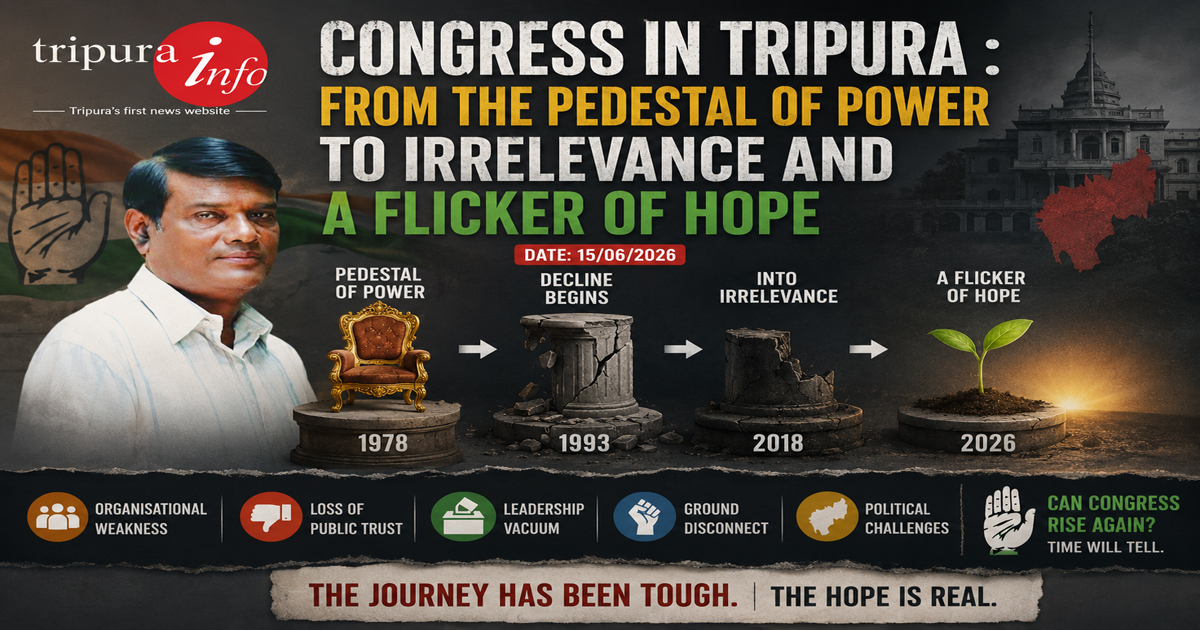
The author Harekrishna Bhowmik in his 142 page treatise based on authentic historical sources and data has provided a brief history of the growth of the party here from scratches alongside the administrative evolution of Tripura from a category ‘C’ state initially to a full-fledged state in 1972 with names of leaders , prominent functionaries who manned the party and frontal organisations. As per data provided by the author the party here has declined from its once-preeminent position to current irrelevance owing to inner bickerings . In fact since the year 1952 up to the year 1977 it was Congress all the way in Tripura’s electoral politics but then came the steep fall, except the brief interregnum of Congress-TUJS coalition rule in 1988-1993, but then it culminated in the disaster three decades later in 2018 when the party was down to zero representation in the 60-member state assembly. What enriches the book is the list of names of all the PCC presidents and top leaders of frontal bodies but a brief light on the ideological position of the party, its fundamental policies and principles on crucial issues might have been interesting read for those keen to learn about Tripura and its political evolution post-merger.
A brief discussion on the emergence of ADC in response to demands from the tribal-based regional parties as well as the Marxists also throws crucial light on an important chapter of state politics. Apart from this, Harekrishna Bhowmik has also revealed his autobiographical details including the way in which he had fallen for Congress with inspiration from his father makes interesting reading . His reminiscences of an unsavoury chapter of state’s history marked by political murders committed by the CPI (M) party during its thirty five year rule revives agonizing memories. The daylight murder of sitting Congress MLA Parimal Saha on April 7 1983 within three months of his election by the CPI (M) goons in co-operation with the state administration and police sheds light on the nature of politics once practiced in this small state. Long 32 years after the murder all the main culprits were sent to rigorous life imprisonment by the high court and the order was upheld by the supreme court in 2017. This had been preceded by the daylight murder of a outstanding Congress organizer and ‘Pradhan’ Prasanna Debnath in 1982 in Salema area under Kamalpur subdivision and the daylight roasting alive of an entire family of Congress supporter Bhagwati Basak in October 1982 by a CPI (M) ‘Pradhan’ Gopi Raman Datta in Kanchanbari village under Kailasahar subdivision.
Besides, readers would recall with pain how the author’s student Panna Lal Biswas alias ‘Gada’ had been brutally hacked to death by a gang of CPI (M) hoodlums on August 15 1987 near the Netaji Subhas college in Udaipur for the cardinal sin of hoisting natonal flag in the college premises alone . What the author is perhaps unaware of is that one of the main killers Arjun Das was rewarded with a job in the ADC by the CPI (M) leadership for having eliminated a political target. This ghastly murder was followed four years later by the mass burning alive of an entire family of a Congress nominated ‘Pradhan’ in Dhalai district by a CPI (M) goon and his accomplices in 1991. Of course the CPI (M) can cite the massacre of fourteen of its local leaders including two security guards by a violent Congress supporter mob at Birchandra Manu in Belonia on October 12 1988 as a mitigating factor.
The book, published in sleek volume by Soma Majumder on behalf of the leading ‘Moumita Prakashani’, is replete with other anecdotes of interest to the inquisitive readers. Perhaps it might have drawn higher readership ,had the author provided a blue-print for Congress’s revival in the state and the follies and foibles including desertions of opportunistic and power-crazed leaders that had led to its downfall in greater details. What however currently appears as a flicker of hope for the beleaguered party is not sustained political struggle or any meaningful growth of political activism but the fast-rising anti-incumbency and silent public anger against the BJP dispensation of the state.
(Tripurainfo)
more articles...