The Story of an Old Man: The Civilizational Shift
Shubhadip Deb Roy
August 13, 2026
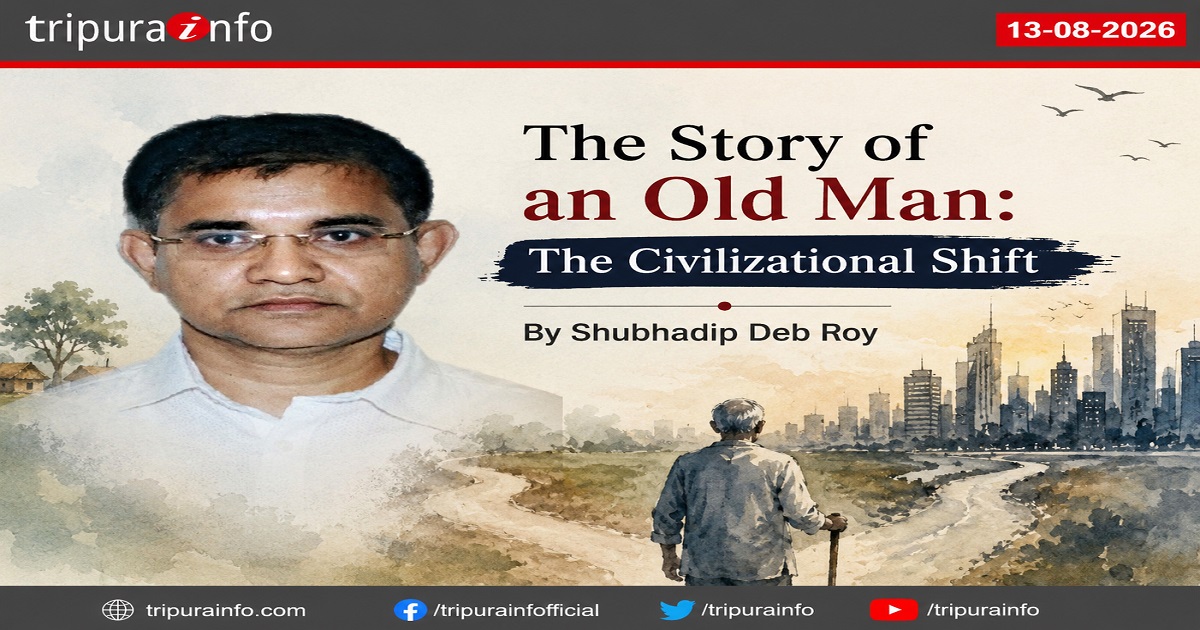
Some news makes headlines. Some news disappears. Some news remains with us because it questions our human values. Some questions our understanding of education and some force us to look deeper into the cultural evolution of the society we are creating.
This is one such story from recent times. A story that went viral on the internet and that's the thought that pushed me to write my own version of that story.
The Story of the Old Man begins.
In a quiet room of an old age home stood a small table. On it rested a photograph of a happy family from another time. A father, A mother, Three smiling daughters. The youngest was in the mother's arms. Another was in the father's arms. The eldest stood between them, holding her father's coat. Everyone was smiling. There was a time when this photograph was not a memory. It was life. Beside the photograph lay a mobile phone. It was not an ordinary phone. It was the bridge between an ageing father and the three daughters he had raised with every ounce of love and care he possessed.
For decades, he had begun his duties before everyone else. He had learnt it by watching his own parents when he was a child. Family first. He organised school bags. He got himself ready to drop his children at school. He worried about school fees and private tuition. He saved money for new clothes during the Puja festivities. He postponed his own wishes. He sacrificed his comforts without ever calling it a sacrifice. It was simply a parental duty.
Three daughters. Three different dreams. Three different lives. But one father's love. He called them Misti, Gori and Pori. The names changed with time. Sometimes they were little names that existed only inside a father's vocabulary of affection. He remembered every milestone. The first cry. The first steps. The sleepless nights. The fever. The wet beds. The examinations. Their worries. Their laughter. Their mischievous moments. Even the smell of their hair. He remembered their weddings. He remembered the tears he tried to hide while blessing them as they began their own lives.
One daughter left. Then another. Then the third. The small house that had once seemed crowded slowly became large. The rooms became empty. The laughter became occasional. The silence became permanent. Yet the elderly couple remained content. They had done what parents believe is their greatest responsibility. They had prepared their children for life.
Then one day, his wife left this world. The silence that followed was louder than any sound. The home they had built together no longer felt like home. He chose to move to an old age home. Not because he had no money. Not because his children had necessarily abandoned him. He had his own savings. He simply did not want to become a burden. Perhaps that too is a form of a parent's love.
Even in old age, he was still trying to make life easier for his children. The caregivers became his companions. They knew when his knees hurt. They knew when his stomach was uncomfortable. They knew when he had a cough and needed hot steam. They knew which medicine had to be given and at what time. They knew his food preferences. They knew exactly how much sugar he liked in his tea. They patiently listened to stories they had heard many times before.
Yet there was one thing even their care could not replace.
The phone.
He waited for it. The calls were few. But whenever it rang, his face changed. "Hello, Baba. How are you?" For a few precious minutes, the old age home disappeared. He was no longer an old man sitting alone. He was a father again. He never complained. He never asked his daughters, "Why don't you come?" Instead, he asked about them. How was work? Were the children studying well? Was everyone healthy? Had they eaten? The same questions. Again, and again. Because a parent's love does not retire.
After every call, he looked at the old photograph. The little girl smiling in his arms. The child who refused to eat until he told her a story. The daughter who would not cross the road without holding his finger. The little girl who jumped into his arms whenever he returned home. Perhaps, somewhere inside, he wondered. When did those tiny fingers become too busy to hold his hand again? How had the world changed so much? How had the man who once meant everything to three little girls become dependent on a mobile phone to hear their voices?
We do not know what his daughters were going through. We should not pretend that we do. There may have been distances. Responsibilities, Circumstances, Illness, Work, Family obligations. There may be a story behind their absence that none of us knows. Empathy requires us to leave room for that unknown story.
But then came his final day. His breathing became slow. His eyes remained open. Perhaps he was still searching for the people he had loved most. The people beside him were his caregivers. One fed him with a spoon. Another adjusted his pillow. Someone held his hand. Someone softly chanted shlokas from the Bhagavad Gita. But Someone at the death bed waited for the last phone call of his life. And when his journey ended, the caregivers gently closed his eyes. A few tears rolled down their cheeks.
The Old man was gone. They stood silently with folded hands before the departed soul. The news later reported that his daughters attended the last rites online and transferred an amount for last rituals online which was later returned by one of the caregivers. The news is viral now.
The Old Man’s Story Ends Here. And the internet erupted. Some shocked, Some angry. Some condemned the daughters. Judgement came quickly. But perhaps we should pause. Because we do not know their entire story.
Yet even after allowing for everything, one uncomfortable question remains. Why do stories like this disturb us so deeply that we are afraid to acknowledge. That the distance between people can grow even when technology makes communication easier. That families can remain connected digitally while becoming emotionally distant. That economic success does not automatically produce social wealth. And this is where the story of that old man meets a story from my own life.
My Story has the same ending. Read it below
Years ago, one of my childhood friends passed away unexpectedly. His death was sudden. He too had a family. He had a daughter whom he loved a lot. His wife lived separately from him but not divorced. He had a widowed mother. His younger sister lived on the other side of the world. Continents away. I was beside his mother, along with another friend, waiting for his sister to arrive. My friends body lay before us. His mother was grieving. His sister was trying to reach home as early as possible. And in that silence, one painful question emerged. Who would perform the Mukhagni? The final offering of fire to the departed. A sacred responsibility traditionally performed by the closest family member. There was hesitation. There was grief. There was helplessness. Will his daughter come forward? Will his estranged wife respond? The silence was more overpowering then the question itself.
And then I stepped forward. Hesitantly, I was not related to him by blood. But connected to him through childhood. We had shared a part of our lives. My friendship created a responsibility that blood alone can’t define. His mother held me tightly and wept. I still can't forget that day of a grieving mother losing her only son. Her grief became my grief. I performed the Mukhagni. I remained with the family. I completed the Shraddha ceremony and continued till the annual rituals for him without breaking any customs and traditional rules laid by the society. Because I believed something very simple. Death does not always end responsibility. Sometimes responsibility begins where relationships by blood cannot reach.
That day taught me something that no classroom had ever taught me. Dharma is not merely a religious word. Dharma is what we do when convenience tells us to step away, but responsibility tells us to stay. And perhaps this is where we need to revisit another set of ideas from our civilizational tradition. Daan, Dakshina, Samarpan. These words are often reduced to rituals. But their deeper meaning is far more demanding. Daan is not simply giving money. It is the willingness to give something of ourselves. Our time, Our resources, Our attention, Our compassion, Sometimes even our comfort. Daan asks us to loosen our attachment to what we possess. Dakshina is not merely a payment to a Guru. It represents gratitude. To Someone who gave us knowledge. To Someone who shaped us. To Someone who helped us become who we are. And we acknowledge that debt with humility. Samarpan goes even deeper. It means offering oneself to a purpose greater than one's individual ego. It is the willingness to say: "This moment is not about me."
When I stood beside my friend's grieving mother, it was not about my convenience. It was not about recognition. It was not about anyone knowing what I had done. It was about being present when someone needed another human being. That is Samarpan. And perhaps the father in the old age home had spent his entire life practising another form of Samarpan. He had given his time. His money. His youth. His comforts. His dreams. He had given everything a father quietly gives to his children. He never calculated the return. That was his Daan. That was his Samarpan. And what he wanted in return was not wealth, Not repayment, Not even duty. He simply wanted presence. A few minutes, A hand to hold, A familiar voice in the room. A daughter saying, "Baba, I am here."
This is why I cannot see these stories as isolated incidents.
These are warning signs. Not necessarily of bad children. Not necessarily of failed parents, but of a society undergoing a profound transformation. Our civilization never rejected wealth. Artha has always been recognised as an important purpose of life. But Artha was placed within a larger framework. Dharma, Artha, Kama, Moksha known as Purusharthas. A Hindu civilizational Philosophy of balancing moral duties, material prosperity, emotional fulfilment and spiritual liberation. Wealth was never meant to become the only measure of a successful life.
Our festivals carried these values into everyday life. During Kumari Puja, we bow before the Divine in the form of a young girl. During Durga Puja, we celebrate the return of the Divine Mother to her parental home. Why does that homecoming move us? Because beneath the ritual lies a profound human idea. A daughter belongs to a family even when she leaves the home. A mother is welcomed. A daughter is remembered. A relationship survives distance. Our rituals were never merely rituals. They were ways of keeping relationships alive.
Our education has given us extraordinary achievements. Science, Medicine, Technology, Global careers, Entrepreneurship, Economic prosperity. We should not reject any of this.
The question is different.
Have we taught our children how to succeed professionally without teaching them how to remain human?
Have we taught them how to accumulate wealth without teaching them how to create social wealth?
Have we taught them how to compete without teaching them when to stand beside someone who cannot compete?
The problem is not modern education. The problem is incomplete education. An education that teaches us how to earn but not how to give. How to achieve but not how to serve. How to speak but not how to listen. How to connect digitally but not how to remain present.
Economic wealth builds prosperous societies. Social wealth builds compassionate civilizations. One gives us better houses. The other gives us homes worth returning to. One increase bank balance, the other increases the value of human relationships. And the greatest crisis we may face one day will not be economic. It may be emotional. It may be social. It may perhaps ultimately become civilizational.
The old father waited for the sound of his daughters' voices. A grieving mother waited for someone to perform her son's final rites. One story came to us through social media. The other became part of my own life. Different families, Different circumstances, Different regions. Yet the same fundamental thoughts remain.
Convenience or moral duty or what when ambition becomes stronger than presence, what when financial wealth grows faster than social wealth.
Can the mobile phone become the bridge to relationships that once needed no bridge at all? And the most uncomfortable question is this. If someone needs us tomorrow, will we have the time? Or will we be too busy building our careers, increasing our wealth, protecting our schedules, or creating our next social media post? If a friend needs us at the most painful moment of his family's life, will we step forward? If an ageing parent needs us, will we go? If someone asks us for nothing except our presence, will we consider that request important enough?
The mobile phone has stopped ringing. The funeral fire has long turned to ashes. The rituals are complete. The mourners have returned to their normal lives. The Instagram pages by now took us to new stories in exotic locations.
But the question remains.
The real question is not whether those daughters failed their father. The real question is whether we, as a society, are slowly forgetting how to be there for one another. Are we becoming richer while becoming poorer in human connection? Are we educating our children for a successful life, but forgetting to educate them for a meaningful one? Is financial wealth mistaken for complete success? Is social wealth losing its relevance? Have we forgotten that Dharma is not merely something we perform in a temple? It is something we practise in the presence of another human being who needs us. The future of our civilization will not be decided only by the wealth we create. It will also be decided by what we are willing to give away. Our time, Our ego. Our comfort, Our gratitude Our presence, Our Samarpan.
The old man's story has ended. My friend's story has ended.
Let us pause. Let us look beyond the headline. Let us look beyond judgement. Let us look within ourselves. And let us ponder for a while. Let us go back to our civilizational values.
Time for a new beginning.
Short stories: Beyond Success
By Shubhadip Deb Roy.
(Tripurainfo)
more articles...