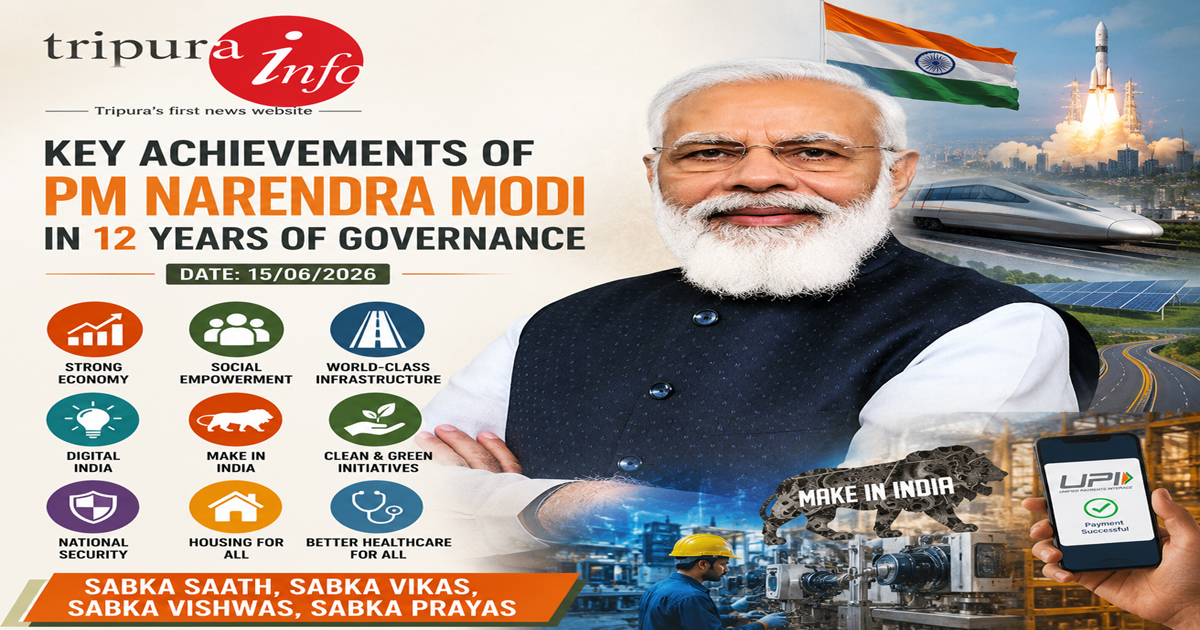
Key Achievements of PM Narendra Modi in 12 Years of Governance
VK Bahuguna
June 15, 2026
(The writer is former IFS officer and Chairman of Centre for Resource Management and Environment)\
Prime Minister Sri Narendra Modi assumed office as Prime Minister of India on May 26, 2014, after the Bhartiya Janata Party (BJP)-led National Democratic Alliance (NDA) won a decisive victory in the Lok Sabha Elections. On 10th May 2026 he had held the office for longest time for 4399 days surpassing the tenure of 4398 days of our first Prime Minister Jawahar Lal Nehru since independence in 1947 winning three consequent elections. He had taken the BJP governments in sates from 7 to 22 covering 72 % of the area of the country and 78% of the population. During the 12 years, his government has not only pursued a vision of Viksit Bharat centered on inclusive growth, self-reliance, digital transformation, and robust infrastructure, standing tall in the comity of nations but also changed the trajectory entire gamut of governance ethos from the past. His tenure has emphasized "Sabaka Saath, Sabaka Vikas, Sabaka Vishwas" (Together with all, Development for all, Trust of all), delivering large-scale welfare, structural reforms, and elevated global stature.While challenges like unemployment and uneven growth persist, tangible outcomes in multiple sectors mark this period.
Economic Reforms and Fiscal Consolidation
One of the most transformative achievements has been the overhaul of India's tax and economic architecture. Indian economy grew from 125.41 lakh crore to 345 lakh crore. The introduction of the Goods and Services Tax in 2017 unified the fragmented indirect tax system into "One Nation, One Tax." It eliminated cascading taxes, simplified compliance, and broadened the tax base, significantly boosting government revenues and formalizing the economy despite initial teething issues. Demonetization in 2016, aimed to curb black money, counterfeit currency, and terror financing while accelerating digital payments. Complementary reforms included the Insolvency and Bankruptcy Code (IBC), which resolved stressed assets worth lakhs of crores, and corporate tax cuts in 2019 that improved India's ease of doing business ranking. India's economy has shown resilience. Nominal GDP roughly doubled to around $4.15 trillion. India emerged as the fastest-growing major economy with strong post-COVID recovery. Foreign exchange reserves reached approximately $670 billion by recent estimates, providing robust import cover. Foreign Direct Investment (FDI) inflows surged due to liberalized policies in defense, railways, and insurance. Initiatives like Make in India have boosted manufacturing in electronics, solar, semiconductors, and pharmaceuticals, attracting global investments. Startup India has catalyzed entrepreneurship, growing the ecosystem from a few hundred to over 3.3 lakh recognized startups, creating millions of jobs. Initiatives like Stand-Up India supported marginalized entrepreneurs. Defense export grew from 1900 crore to 23,000 crore now. These measures positioned India as the world's third-largest economy in purchasing power parity terms and enhanced macroeconomic stability. The Per capita income rose from Rs 86647 in Rs 2014 to 219575.
Infrastructure Boost:
The true nature of improved governance is visibly seen in Infrastructure Revolution and stands as a hallmark of Modi's governance. The government invested heavily in roads, railways, airports, and ports under the Gati Shakti National Master Plan, integrating planning for multimodal connectivity. National highways expanded dramatically, with Bharatmala scheme adding tens of thousands of kilometers. Railways electrification, high-speed corridors, Vande Bharat trains, and station redevelopment modernized the network. Dedicated Freight Corridors improved logistics efficiency.
The number of operational airports rose from around 74 to over 160, with UDAN scheme making air travel affordable for smaller towns. In Renewable Energy: Solar capacity jumped from 2.6 GW to over 110 GW, supported by the International Solar Alliance (co-founded with France). India advanced toward its Paris Agreement commitments. Rural infrastructure saw massive gains through schemes like PM Gram Sadak Yojana (all-weather roads), Jal Jeevan Mission (tap water to households is one the best example of his leadership as out of 19.35 crore household 15.82 crore have been covered a big jump from 3.23 crore in 2019covering 81.8% of the population. It has saved lakhs of children, women and elderly from water related diseases), and quality as well as quantity of electrification of nearly all villages from 12 hours to 22 hours. One of the biggest achievements are in road infrastructure and connectivity. The National Highways had increased from 98,000 km had increased it to 1.46 lakh kms. These projects not only boosted connectivity but also created millions of jobs and enhanced economic productivity.
Welfare Schemes: Empowering the Last Mile
Modi's government prioritized direct benefit transfers (DBT) to minimize leakages, saving over ₹3 lakh crore; Pradhan Mantri Jan Dhan Yojana (PMJDY): Over 58 crore bank accounts opened, promoting financial inclusion, especially for women and rural populations. Construction of over 12 crore household toilets under Swatch Bharat, significantly improving sanitation and public health, with India declaring itself Open Defecation Free. Over 10 crore LPG connections provided to poor households, reducing drudgery for women and indoor pollution. Ayushman Bharat (PM-JAY): Health insurance cover of ₹5 lakh per family for over 55 crore beneficiaries, one of the world's largest public health programs and finest example of gift to people. Crores of houses built or sanctioned for the poor and food security for 80 crore people during and post-COVID. Other initiatives like Beti Bachao Beti Padhao advanced gender equality, while schemes for farmers (PM-KISAN), skill development (Skill India), and pensions strengthened social safety nets. These "basics-first" programs delivered dignity and opportunities to millions, particularly in rural and marginalized communities. One of his government’s most outstanding contribution I have observed personally has been the marked change in uplifting the more than 15 lakh Muslims artisan through “Hunar Haats in Pragati maidan and other exhibitions which I have been visiting regularly fort past more than 15 years and more. Never before this has happened. This is ironically despite the Muslims doggedly not voting for his leadership during the elections including his own constituency Varanasi.
Digital Transformation and Innovation
India's digital leap under Modi is globally recognized. The Unified Payments Interface (UPI) revolutionized payments, with transactions surging from negligible levels in 2016 to over 22 billion monthly by 2026, handling trillions in value. India conducted one of the world's largest vaccination drives. The semiconductor and AI push, alongside data localization and cyber security measures, positioned India for the Fourth Industrial Revolution.
Foreign Policy and National Security
Modi's personal diplomacy elevated India's global profile. The evacuation of citizens from conflict zones and vaccine diplomacy during COVID showcased soft power. On security, the abrogation of Article 370 in 2019 integrated Jammu and Kashmir fully, while surgical strikes, Operation Sindoor and Balakot demonstrated a proactive stance against terrorism. Coastal security and border infrastructure improved.
Governance and Other Reforms Triple Talaq abolition protected Muslim women. Labour codes streamlined regulations. Transparency initiatives like DBT, coal block auctions (generating massive revenue), and anti-corruption drives restored institutional credibility. Women's empowerment saw increased representation in various sectors. In 12 years, PM Modi's leadership has been a paradigm shift in all directions. India transitioned toward a more self-reliant, digitally empowered, and infrastructurally robust nation, with welfare reaching the grassroots. As India eyes developed nation status by 2047, these foundations provide a strong platform. Time is ripe for other reforms. The era reflects a blend of bold reforms and mass empowerment, reshaping India's trajectory on the world stage.
(Tripurainfo)
more articles...