NEPAL Cryosphere collapse : It is time for Global South-South Climate Action
VK Bahuguna
September 6, 2026
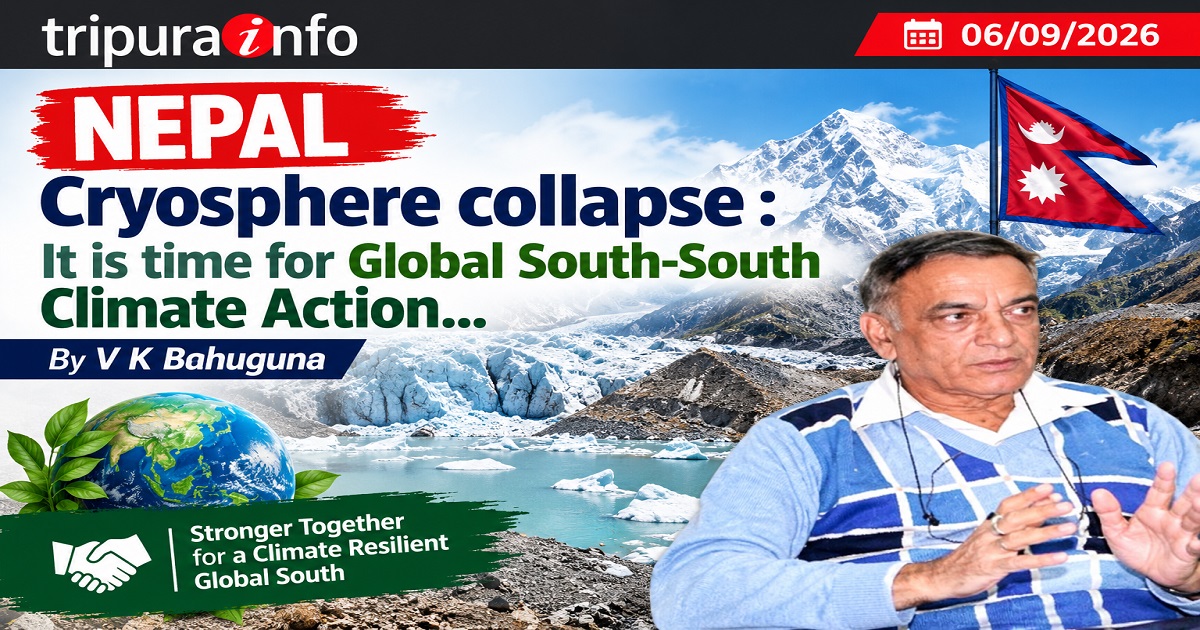
The catastrophic mountain collapses in early hours of 26th August 2026 in Tibet and deadly glacial outburst floods across Nepal are no longer isolated natural anomalies—they are like a last warning to humanity and people living in Hindu Kush region. When glacial lakes burst their banks and wash away entire Himalayan villages, Nepal serves as the world's primary indicator: the climate crisis is no longer a distant theoretical threat; it is an active ecological emergency and has now reached every household and this writer has been continuously writing about it and speaking in all forums and warning the political and administrative leadership.
As global average temperatures continuously hover beyond the 1-degree Celsius threshold above pre-industrial levels—with individual land temperature spikes already soaring past 1.5 degree Celsius, the United Nations Framework Convention on Climate Change (UNFCCC) CoPs have proven to be a monumental failure and at best a Jamboree gossiping till mid nights and then coming up with face saving vacuous declaration by the host country. The developed nations, responsible for the vast majority of historical carbon emissions, continue to show a staggering lack of remorse. They offer empty pledges at annual summits while hoarding green technology and shirking their legal and financial damage commitments and blaming only India and China to recuse themselves from their historical responsibility.
If the Global South specially group of 77 and China continues to wait for Western goodwill, it will inherit a ruined planet with devastation like Nepal spread all over the humanity. The Cracks are already to see. We do not need to project into the future to witness the chaos of a warming planet, the indicators are already here. Already the IPCC projection of limiting temperature rise in the range of 1.5 degree Celsius in the beginning of 2100 Century threshold had already neared in the year 20230. The ominous sign of shrinking Glaciers & consequence Floods in the Himalayas due to breaking of glacial lakes in Uttarakhand, Himachal and Nepal and the broader Hindu Kush region, temperature rises are occurring at double the global average, melting ice reserves that supply freshwater to over 1.3 billion people downstream affecting 200 crore people and their infrastructure. There are signs of extreme land warming as while ocean temperatures rise steadily, global land areas have already experienced sustained thermal spikes over above pre-industrial baselines (Earth had warmed 1.1to 1.4-degree Celsius since pre industrial era) during recent heatwaves, breaking records across Asia, Europe, and South America. Unprecedented Heat Stress is being witnessed over half of the global land surface now as prolonged stretches of extreme heat stress annually, are disrupting power grids, shutting down schools, and pushing human physiological limits.
Let us discuss about the scenario when the temperature rise will be 2 degrees Celsius. If the global temperatures cross the 2 degrees Celsius the localized tragedy of Nepal will become the daily reality for billions across the globe and therefore, we will witness a near-total ecosystem collapse. It is feared that over 99% of tropical coral reefs—the nurseries of marine life—will die off permanently, wiping out fisheries that sustain hundreds of millions of people. Further, roughly 37% of the human population will be exposed to severe, deadly heatwaves at least once every five years. Tropical and equatorial regions will experience "wet-bulb" days. The wet-bulb syndrome is a dangerous weather condition where high heat and high humidity combine so that the human body cannot cool itself through sweating. There is going to be a cascading food and water Insecurity which is going to severely compromise the agricultural yields for critical staples like maize, wheat, and rice sharply across tropical zones, while severe droughts double in frequency across Southern Africa, Asia, the Mediterranean, and South America.
There is therefore, an urgent need for a strategic shift as this writer has been advocating since past five to six years in his writings in national newspapers beseeching the mandarins in Ministry of External affairs, Prime Minister’s office and the Environment Ministry to immediately organize a South-South Climate summit of group of 77 plus China which represent the 134 Countries now and thus 80% of the world population to counter the lackadaisical and selfish attitude of developed world. This is essential as the UNFCCC mechanism is paralyzed by Western double standards, the developing world must pivot to self-reliance. As stated above the major emerging economies—specifically India, China, and Brazil—must spearhead a dedicated South-South Climate Technology Summit to directly transfer and scale green solutions across vulnerable nations without Western patent gatekeeping or predatory debt traps. In this regards the China’s advanced solar manufacturing, India’s ultra-low-cost green hydrogen and grid-scale renewables, and Brazil’s agricultural bio-energy must be pooled to allow open-access vault for developing states.
From the point of view of Himalayan & equatorial early warning systems, India, China and Nepal need to establish Joint satellite networks operated by ISRO, CNSA, and partner agencies must provide free, real-time glacial, atmospheric, and oceanographic monitoring data to frontline nations like Nepal, Bangladesh, and small island states. Further countries having technology must provide Patent-Free Climate Resilient technologies for agriculture along with establishment of a collaborative research programmes for drought-tolerant seed varieties and share precision-irrigation models tailored to tropical climates. Another important thing needed is to evolve grassroots Climate Resilience for Every Household and for this the macro-level political shifts must be matched by a micro-level transition. Families can no longer rely on fragile centralized infrastructure; every household must adopt a climate-resilient lifestyle to weather the coming shocks. Water conservation is another area which the developing countries must act both at the village and city levels and promote rooftop water harvesting & greywater reuse by installing basic rainwater catchment systems and recycling household sink water reduces dependency on municipal supplies during climate-driven droughts and flood-induced contamination. To reduce the impact of heat waves painting house roofs with high-albedo reflective white coatings will lower indoor temperatures offering vital thermal protection without relying on power-hungry air conditioning. In this regards the Prime Ministers roof top solar systems and off-Grid micro small rooftop solar kits with battery backups ensure uninterrupted access to lighting, communications, and water pumping when national power grids fail during extreme weather events must be evolved through a scheme especially in rural areas in a big manner. For food security the households should utilize micro-spaces like balconies, yards, rooftops etc to cultivate hardy, nutrient-dense native crops—such as millets, sweet potatoes, and local greens—that thrive with minimal water and supplemented by decentralized seed banks, local composting networks, and emergency relief committees to act immediately when extreme weather strikes. Nepal’s melting peaks are and occasion for Indian leadership to lead the global south. This tragedy also is an early warning signal for the rest of humanity. The Western-dominated climate negotiation framework has failed to deliver equity or safety. By forging a unified South-South technological alliance and fortifying our homes through grassroots resilience, the developing world can build its own defence against a warming world. The era of waiting for permission or help is over; survival demands immediate action. (Formerly Director-general of Indian Council of Forestry Research and Education, Ministry of Environment, Forest and Climate Change and is Chairman of Centre for Resource Management and Environment)
(Tripurainfo)
more articles...